

Reading time: 18 min
Key Takeaways
- The evolution of golf clubs is a materials story, not a product list. Wood gave way to iron, hickory to steel, steel to graphite, and persimmon to titanium, and every shift was forced by the ball or by a rule change.
- The gutta-percha ball of 1848 broke the wooden club era. Once balls could survive hard contact, iron heads made sense, and drop forging in the late 1800s made them repeatable.
- Steel shafts around 1929 and graphite around 1970 changed how clubs felt, not just how they looked. Consistency and weight replaced the lottery of hand-split hickory.
- Since 2005 the gains have been incremental. Adjustability, better fitting, AI-assisted launch data, and sustainable materials define the 2026 landscape, not radical new shapes.
What Is the Evolution of Golf Clubs?
What if the most important change in golf history was not a new swing, but a new shaft? That question sounds like a provocation. It is not. The evolution of golf clubs is the six-hundred-year record of how a ball, a piece of ground, and a pair of hands negotiated with each other, and how the tool in the middle kept getting rebuilt to keep up.
Most articles on golf club history hand you a tidy list of dates and stop there. That is like reading a scorecard instead of playing the round. According to Magnolia Point Golf Club, golf in Scotland is dated to September 30, 1400, and those first clubs were made by the players themselves, with no standard design or shape (2017). Six hundred years later, we argue about weighting tracks and shaft profiles. The thread between those two moments is what this piece is about.
Definition: The evolution of golf clubs is the long-term change in five connected things — materials (wood, iron, steel, graphite, titanium), head shapes (longnose, cleek, blade, cavity-back, metal wood, hybrid), shafts (ash, hickory, steel, graphite, composite), manufacturing (hand carving, blacksmithing, drop forging, casting, multi-material assembly), and rules and fitting (the 14-club limit, groove rules, launch monitors, adjustable hosels). Change one and the others follow.
From Handcrafted Tools to Engineered Equipment
Picture a player in the 1500s. He picks a length of ash or hazel for the shaft, finds a piece of apple or beech for the head, and shapes it until it looks right to him. There is no catalogue, no spec sheet, no standard. Two clubs from the same workshop could swing like different sports. That is not a charming detail — it is the whole problem the next four hundred years were spent solving.
Every real leap in golf equipment answered a specific failure. Wooden heads split on hard balls. Hickory shafts snapped and varied in flex from one to the next. Crude irons were brittle and inconsistent until drop forging arrived. Steel shafts were resented at first and then became the standard everyone copied. Graphite made light clubs possible. Titanium let designers build a driver head the size of a fist without making it heavy. Nothing changed for elegance. It changed because something was breaking.
Why Club Evolution Matters in 2026
Here is the thing nobody talks about: history is the only honest filter we have for equipment marketing. When a manufacturer tells you their new iron is a breakthrough, knowing that cavity-back irons arrived in the 1960s with perimeter weighting gives you perspective. The idea is sixty years old. The execution is better. Those are different claims.
I have played that shot a thousand times — the one where a player buys forgiveness and still misses the green, because the club was never the problem. Understanding how we got here helps you separate a genuine gain from a cosmetic update. That is worth more than any launch monitor number.
Now let us put the dates on the table, because the sequence is where the story actually lives.
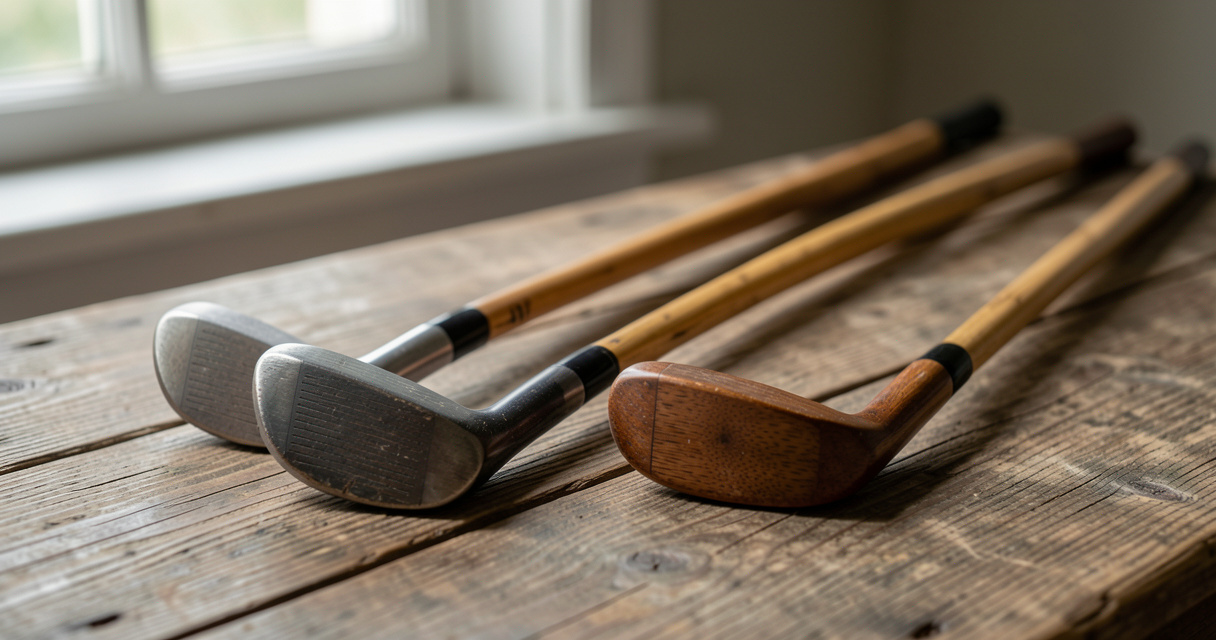
The Complete Evolution of Golf Clubs Timeline: 1400 to 2026
The golf club timeline below is the whole arc in one pass. If you only read one part of this article, read these six steps.
- 1400s: Handmade wooden clubs in Scotland had no standard shape or length.
- 1500s: Early club types such as longnoses and spoons began to take recognizable form.
- 1800s: Iron heads and drop forging improved durability and repeatability, with iron-headed clubs widely adopted around 1875.
- 1920s to 1930s: Steel shafts replaced hickory around 1929, and the modern sand wedge appeared.
- 1960s to 2005: Cavity-back irons, graphite shafts around 1970, metal woods, and larger titanium drivers arrived.
- 2005 to 2026: Adjustability, AI-assisted fitting, smart-club concepts, and sustainable materials drive incremental gains.
1400 to 1600: Wooden Clubs and Featherie Balls
According to Magnolia Point Golf Club, by September 30, 1500, the first golf clubs began to take shape as the game gained popularity (2017). Shafts were ash and hazel. Heads were apple, holly, beech, or pear — dense woods that could take a hit. And the ball was the featherie, a leather pouch stuffed with boiled feathers and sewn shut. It flew well for its day and it fell apart in the rain. Clubs had to be gentle with it.
1600 to 1800: Hickory, Blacksmiths, and Early Irons
Hickory became the shaft of choice because it was strong, flexible, and — crucially — available. Blacksmiths started forging iron heads for the shots where wood was too fragile: escapes from ruts, heavy rough, hardpan. These were not refined instruments. They were tools of necessity, and they were the first crack in the wooden monopoly.
1800 to 1920: Gutta-Percha, Drop Forging, and Steel Shafts
According to Magnolia Point Golf Club, iron-headed clubs were adopted around October 30, 1875, aided by drop forging in the late 1800s (2017). Drop forging is the quiet hero of this era. Instead of one blacksmith shaping one head by eye, a die could stamp the same head over and over. Consistency entered the game through the workshop door. Add a harder ball and you had a decade of genuine upheaval.
1920 to 2005: Steel, Graphite, Cavity Backs, and Titanium
According to Magnolia Point Golf Club, steel shafts were developed around September 30, 1929, increasing accuracy but requiring a different swing technique (2017). Traditionalists grumbled. They always do. Then graphite arrived around September 30, 1970, making clubs lighter and easier to manufacture. By September 30, 2005, modern clubs included larger driver heads, metal woods, and titanium-based club heads. In eighty years the game went from a hickory stick to a 460cc driver.
2005 to 2026: Adjustability, AI Fitting, and Material Science
| Era | Ball Type | Club Material | Key Innovation | On-Course Impact |
|---|---|---|---|---|
| 1400-1600 | Featherie | Ash, hazel, apple, beech | Hand-carved wooden heads | No standardization; feel varied wildly |
| 1600-1800 | Featherie | Hickory shaft, early iron heads | Blacksmith-forged irons | Escape shots became possible |
| 1800-1920 | Featherie to gutta-percha | Drop-forged iron | Repeatable forging, harder ball | Consistency and durability improved |
| 1920-1970 | Gutta-percha to wound rubber | Steel shaft, forged blades | Steel shafts, sand wedge | Accuracy and shaft consistency |
| 1970-2005 | Modern solid-core | Graphite, titanium, cast iron | Cavity backs, metal woods | Forgiveness and distance gains |
| 2005-2026 | Modern solid-core, governed | Multi-material, composites | Adjustability, AI fitting | Incremental tuning, not reinvention |
Bobby Jones figured this out in 1928, long before any of it: the tool matters less than the marriage between tool and player. The timeline proves it. Every era’s best players won with whatever was in the bag — and then adapted when the bag changed. What changed the bag most? The ball. That is the next section.
How Materials Changed Golf Clubs: Wood, Iron, Steel, Graphite, and Titanium
Ask what materials early golf clubs were made from and most people say “wood” and leave it there. The honest answer is more interesting. Shafts were ash, hazel, then hickory. Heads were apple, holly, beech, and pear — chosen for density and how they held a shape. Every one of those choices was a trade-off, and every trade-off shaped how the game was played.
From Hickory and Ash to Steel Shafts
Hickory was the best wooden shaft anyone found. It was strong, it flexed, and it survived. It also had a personality. Two hickory shafts cut from the same tree could behave differently, and a player had to learn each one individually. That is why old sets were enormous and deeply personal — you carried the clubs that happened to work.
Steel ended that lottery. According to History of Simple Things, steel shafts introduced in the 1920s reduced breakage and improved accuracy, though traditionalists resisted at first (2025). Of course they resisted. The same argument happens every generation, just with different vocabulary. Why did steel shafts win? Because they were identical from club to club. Consistency is not glamorous. It is just better.
Iron Heads, Drop Forging, and Perimeter Weighting
Iron heads existed by the mid-1700s, but they were crude and brittle. Drop forging in the late 1800s changed the economics and the quality at once. Then casting, decades later, allowed designers to move weight around the head instead of just behind the ball. Perimeter weighting was the idea; the cavity-back iron was the delivery mechanism. The difference between forged and cast irons is not snobbery — it is a difference in how the head is made, how the weight sits, and how the strike feels in your hands.
Graphite, Titanium, and Composite Components
According to Magnolia Point Golf Club, graphite shafts were introduced around September 30, 1970, making clubs lighter and easier to manufacture (2017). Lighter meant faster for many players, and easier manufacturing meant graphite spread from drivers into fairway woods, hybrids, and eventually irons.
Titanium solved a different problem. Driver heads were growing, and steel was getting heavy. Titanium let designers build a bigger head without making it unusable. Add composite crowns and movable weights and you get the 2026 driver — a multi-material assembly, not a single forged object. Here is the golf club materials comparison that matters.
| Material | Era | Main Benefit | Main Limitation | Typical Club Use |
|---|---|---|---|---|
| Ash / hazel | 1400s-1600s | Available, workable | Inconsistent, broke easily | Shafts |
| Apple / beech / pear | 1400s-1800s | Dense, held shape | Split on hard impacts | Wooden heads |
| Hickory | 1600s-1920s | Strong, flexible | No two alike, snapped | Shafts |
| Forged iron | 1750s onward | Durable, workable | Crude until drop forging | Irons, wedges |
| Steel | 1929 onward | Consistency, durability | Heavier, less feel | Shafts, iron heads |
| Graphite | 1970 onward | Light, tunable | Cost, inconsistent early quality | Drivers, woods, irons |
| Titanium / composite | 1990s-2026 | Large heads, low weight | Cost, complexity | Drivers, fairway woods |
Materials only tell half the story. The other half is the thing the club is trying to hit — and that relationship was never a straight line of progress. It was an arms race.
The Ball-Club Arms Race: How Featherie, Gutta-Percha, and Modern Balls Forced Club Innovation
The golf ball and club evolution story is a chain of reactions, not a timeline of inventions. Change the ball and the club becomes obsolete overnight. Change the club and someone builds a better ball.
Featherie Balls and Fragile Wooden Clubs
The featherie was the standard by 1618, and it was a beautiful, expensive, fragile object. It also demanded a certain kind of swing — smooth, sweeping, careful. You did not attack a featherie. You coaxed it. Wooden heads were not a limitation so much as a matching partner.
Gutta-Percha and the Rise of Iron-Headed Clubs
In 1848 the gutta-percha ball replaced the featherie, and everything shifted. Gutta-percha was cheap, tough, and could take a real strike. Wooden heads started splitting. Iron heads became not just viable but preferable. Why did gutta-percha change golf clubs? Because a ball that survives impact invites a swing that was previously impossible.
Picture the workshop. A club maker in the 1850s watches a player take a hard swipe with a wooden-headed play club. The head splits along the grain. Again. He picks up the pieces, walks back to the forge, and starts thinking about iron — not because iron is fashionable, but because the ball he cannot control has just changed the terms of his trade. That is how most of this history actually happened. Not in a laboratory. In a workshop, after a breakage.
Modern Ball Rules and Equipment Design
The arms race never ended; it just got governed. Ball distance limits, groove rules, and head size caps all exist because the two sides of the equation keep pushing each other. The future of golf clubs will be written inside those guardrails. When a rule freezes one variable, engineers attack the next one — weight placement, face material, shaft profile, adjustability.
That constraint is why the modern era looks so incremental. The ball is regulated. The head size is capped. What is left is tuning. And tuning is exactly what the shapes of the last sixty years were built to receive.
From Longnose to Hybrid: How Club Shapes and Lofts Evolved
The golf club head design evolution is easier to follow if you learn the old names. Each one solved a specific shot, and each one has a modern descendant.
Play Clubs, Longnoses, Spoons, Niblicks, and Cleeks
The play club was the driver of its day — a long wooden head used off the tee. The longnose was an early wooden club with a long, slender head, prized for distance but unforgiving on the ground. The spoon had a curved face to lift the ball, the ancestor of the fairway wood. The niblick was the escape club, heavy and lofted, the great-grandfather of the sand wedge and gap wedge. The cleek was a narrow iron with a hooked face, used for low running shots and approach play.
- Play club → modern driver → tee shots
- Longnose → early wooden driver → maximum distance
- Spoon → fairway wood → lifting the ball off turf
- Cleek → long iron / utility iron → low running approaches
- Niblick → sand wedge / lob wedge → escape from sand and rough
- Mashie → mid iron → general approach shots
- Jigger → chipper / hybrid → short running shots
The Sand Wedge and the Modern Wedge System
The sand wedge is a twentieth-century answer to a very old question the niblick had already asked. Once courses started building real bunkers and real green complexes, one escape club was not enough. Loft became a system — pitching, gap, sand, lob — each with a job. That is a modern idea: instead of one club doing everything, you carry four doing specific things well. The 14-club limit made that choice a design problem instead of an accident.
Cavity-Back Irons, Metal Woods, and Hybrids
According to History of Simple Things, cavity-backed irons emerged in the 1960s and used perimeter weighting to improve forgiveness (2025). That is the single most important design idea in iron history, and it has never really been improved — only refined. Move weight away from the center and a slightly off-center strike loses less speed. Simple principle. Sixty years of engineering.
Metal woods replaced persimmon for the same reason: hollow metal let designers move weight where wood could not. Hybrids then merged the two — a wood-like shape with an iron-like face, built for the player who cannot reliably launch a long iron. I have played that shot a thousand times, the 3-iron from a tight lie, and I know exactly why the hybrid exists.
Adjustable Hosels and Moveable Weights
An adjustable hosel lets a fitter change face angle and loft without rebuilding the club. Moveable weights shift the center of gravity forward or back to change spin and launch. Neither makes a bad swing good. Both let a good swing be better matched to the tool. That is the real contribution of post-2005 design.
Which brings us to a rule most players have never thought about — the one that decided how many of these clubs you are allowed to carry.
The 14-Club Rule and the Shift from Handcrafted Sets to Fitted Systems
How many clubs did players carry before the 14-club rule? Twenty to thirty, sometimes more. That sounds absurd until you remember that every hickory club was a one-off. If one niblick worked and another did not, you carried both. 14 club rule history is really the history of clubs becoming reliable enough that one of each would do.
The 14-club rule: A golfer may carry no more than 14 clubs in a round. It matters because it forces a set to be built rather than assembled — every slot is a trade-off between distance, control, and versatility. It is the reason modern fitting is about gaps and coverage, not just about which club is longest.
Why Early Golfers Carried 20 to 30 Clubs
Handmade clubs varied. Two niblicks were not two copies of one idea. A player might carry three spoons because one flew lower and one sat down softer. The bag was a collection, not a system. Nobody thought that was excessive. It was the only way to be sure.
Standardization, Steel Shafts, and the 14-Club Limit
Steel shafts made every club in a set behave predictably. That single change made a 20-club bag unnecessary. Once a 5-iron was a 5-iron, you did not need three of them. The 14-club rule followed the arrival of durable, consistent all-metal clubs, and it reshaped how golfers think: fewer clubs, chosen deliberately.
Modern Fitting, Launch Monitors, and Custom Sets
Couple that with launch monitors and you get the 2026 set: gapped, measured, and matched to a swing rather than bought off a rack. AI-assisted fitting does the same job faster — it crunches the numbers and suggests a build. Useful. Not magic. The fitter’s eye still matters, especially on a windy afternoon when the monitor reads better than the ball flies.
So where does that leave us? Has the whole thing stalled, or is there more coming?
Has Golf Club Evolution Slowed? What Changed After 2005 and What Comes Next by 2026
Ask whether golf clubs are still evolving in 2026 and the honest answer is yes — but not in the way the advertising implies. Treat 2005 as the modern baseline. That is the year the big moves were already done: large driver heads, metal woods, titanium, graphite nearly everywhere, cavity-backs standard. Everything after that has been refinement.
Haggin Oaks notes there have not been many significant design changes for roughly two decades. That is not a knock on engineers. It is what a mature design looks like. When the shape is solved, the gains move into materials, tolerances, and fitting.
Incremental Gains: MOI, Adjustability, and Better Materials
Higher moment of inertia, better weight distribution, tighter manufacturing tolerances, thinner faces with more reliable spring, lighter and more consistent graphite. None of it changes the game the way steel shafts did. All of it makes a well-fitted club work a little better for a specific player. That is a real gain. It is just not a revolution, and the difference matters when you are about to spend money.
Warning: Separate genuine performance gains from marketing language. A real gain can be measured in a fitting bay against your own club, with your own ball, on more than one day. A marketing claim is a word like “explosive” or “tour-level” printed on a box. If you cannot see the difference in your own ball flight, it is not a gain — it is a paint job.
Smart Clubs, AI Fitting, and Sustainable Materials
The 2025 YouTube source points to AI, smart clubs, real-time adaptation, and sustainability as future directions. I am skeptical but not retrograde. Sensors that log strike location could genuinely help a player practice better — that is information, not decoration. Sustainable materials are a straightforward improvement. Real-time adapting clubs? Show me one that survives a winter in a Michigan garage and we will talk.
What the Next Decade Could Bring
Expect more adjustability, not new shapes. Expect fitting to become cheaper and more data-driven. Expect materials that are lighter and more recyclable. Expect the rules to keep the ball in check, which keeps the clubs in check with it. The game does not owe you a breakthrough. It owes you a tool that fits — and that is available right now, if you are willing to be measured.
The real question for most readers is not what the industry will do. It is what you should put in your bag. History is a practical guide here, not a museum.
How to Use Golf Club History When Choosing Clubs in 2026
When you choose golf clubs 2026-style, the useful move is to read your own game through the trade-offs history already solved. Shaft material, head shape, forgiveness, and adjustability each exist for a reason. Match the reason to your swing.
Match Club Technology to Your Swing
- Shaft material: steel for control and consistency if you load it hard; graphite for lighter weight if speed or joint comfort is the constraint.
- Head type: cavity-back if you want help on off-center strikes; blade if you strike the center and want feedback.
- Forgiveness: perimeter weighting is sixty years old and still the best value in golf equipment.
- Adjustability: worth it if you play varied conditions or change your swing; dead weight if you never touch it.
- Fitting: the highest-return hour you can spend. Lie angle and shaft length matter more than the marketing on the box.
- Budget: last generation’s fitted set beats this generation’s off-the-rack set every time.
- Practice time: be honest. If you play twelve rounds a year, buy the forgiving version.
Budget vs Custom Fitting
If you have a fixed budget, spend it on the fitting before the technology. A measured set built around your swing beats an expensive set built around a brochure. That’s not a tip — that’s a truth, and it has been true since the first club maker watched a player and adjusted the lie.
What Old Clubs Can Still Teach You
Take a blade and a hickory-shafted club to the range once. Not to play with — to feel. Walk the course with fewer clubs and you will learn the thing the 14-club rule has been quietly teaching for a century: the game doesn’t owe you anything, and a smaller bag forces better decisions. You will understand your gaps in about nine holes.
Frequently Asked Questions
When were steel shafts introduced in golf clubs?
Steel shafts were developed in the 1920s, with a key milestone placed around 1929. They improved consistency and durability compared with hickory, though some traditionalists resisted the change at first.
What were the first golf clubs made of?
Early golf clubs were made mostly from wood, including ash or hazel shafts and tougher wooden heads such as apple, holly, beech, or pear. They were handmade, so weight, feel, and performance varied widely.
Why did iron-headed clubs replace wooden clubs?
Iron-headed clubs became more common as golf balls became harder and more durable. Drop forging in the late 1800s made iron heads easier to produce and more effective than crude early irons.
How did the gutta-percha ball change golf clubs?
The gutta-percha ball replaced the featherie in 1848 and could withstand harder impacts. That pushed club makers toward iron-headed clubs that could handle the new ball without splitting wooden heads.
When did graphite shafts become common?
Graphite shafts were introduced around 1970. They offered a lighter alternative to steel and became easier to manufacture, eventually spreading across drivers, fairway woods, hybrids, and irons.
Why is the 14-club rule important in golf history?
Before durable all-metal clubs, players sometimes carried 20 to 30 clubs. The 14-club rule forced golfers to build more purposeful sets and helped standardize how modern equipment is chosen and fitted.
Are golf clubs still evolving in 2026?
Yes, but mostly through incremental changes rather than radical redesigns. Current evolution focuses on adjustability, materials, AI fitting, smart-club concepts, and sustainability, while the core shapes of irons, woods, and wedges remain familiar.
The Bottom Line: Six Centuries of Better Tools
Here is the short version of everything above. Golf clubs evolved from handmade wooden tools into engineered systems shaped by materials, rules, and ball technology. The biggest shifts came from iron heads, steel shafts, graphite shafts, cavity-back irons, metal woods, and titanium drivers. After 2005, change became more incremental, with adjustability, fitting, AI, and sustainability driving the 2026 story. And that history and evolution of golf clubs helps modern golfers choose wisely by exposing the trade-offs in materials, head shape, forgiveness, and fitting.
None of it was inevitable. Every improvement on that timeline happened because someone got tired of breaking something or missing something. Traditionalists fought steel shafts. Players resisted metal woods. The argument did not stop the change because the change was real. What you should take from it is a filter: if a new club does not solve an actual problem in your actual ball flight, it is not progress for you. It is just new.
Walk the course. Take fewer clubs than you think you need. Pay attention to what fails — the shot you cannot hit, the gap you keep guessing at. That information is worth more than any launch monitor printout, and it is free.
So — which part of golf club evolution will shape your next set: the shaft, the head design, or the fitting process?

Playing golf since before GPS rangefinders existed. Eddie covers the classic game — courses, technique, and the stories worth keeping.