

Reading time: 18 min
Key Takeaways
- Slope vs. Course Rating: Slope measures relative difficulty for bogey golfers vs. scratch golfers; Course Rating measures expected score for a scratch golfer.
- 113 is a baseline, not an average: The USGA uses 113 in handicap formulas, but the real-world average slope in the US is about 120 (SCGA, 2024).
- Slope affects your course handicap: Higher slope increases your course handicap; a 15-handicapper may get 3-4 extra strokes on a slope 140 course vs. 113.
- Check both numbers: Always look at both Course Rating and Slope on the scorecard to choose the right tees and understand the challenge.
What Is Slope Rating? (And How It Differs From Course Rating)
I’ve been playing this game for thirty-six years, and I still meet golfers who confuse slope rating with course rating. Here’s the thing nobody talks about: slope rating is not a score. It’s a comparison tool. The USGA defines it as a measure of the relative difficulty of a course for a bogey golfer compared to a scratch golfer. In plain English: how much harder does the course get for someone who shoots around 90 compared to someone who shoots even par?
Why We Have Two Numbers: Course Rating and Slope Rating
Every rated set of tees gives you two numbers. Course Rating tells you what a scratch golfer should shoot. Slope Rating tells you how much harder it is for a bogey golfer. The USGA sets slope ratings on a scale from 55 to 155. A slope of 113 is the baseline — the point where the difficulty for a bogey golfer is exactly proportional to a scratch golfer. But don’t mistake that for “average.” More on that soon.
| Feature | Course Rating | Slope Rating |
|---|---|---|
| What it measures | Expected score for a scratch golfer | Relative difficulty for bogey vs. scratch |
| Who it’s for | Scratch golfers (0 handicap) | All golfers, especially higher handicaps |
| Range | Typically 67–77 (strokes) | 55 to 155 |
| Used for | Base difficulty gauge | Course handicap calculation |
According to the SCGA (Southern California Golf Association), slope ratings can range anywhere between 55 and 155 (2024). A course with a slope of 130 doesn’t mean it’s harder for everyone — it means the course punishes bogey golfers significantly more than scratch golfers. Bobby Jones figured this out in 1928 when he said, “A course that tests the scratch player fairly may be impossible for the high handicapper.” That’s the essence of slope.

Average Slope Rating: Why 113 Is Standard but 120 Is Reality
The average slope rating for a golf course in the United States is approximately 120, according to the SCGA (2024). However, the USGA uses 113 as the standard baseline in handicap calculations. This means most courses are relatively harder for bogey golfers than the baseline suggests, but 113 remains the neutral reference point. That’s the short answer. Now let me explain why these two numbers exist and why they matter to your game.
Why 113 Became the Standard
Back when the USGA developed the slope system in the 1980s, they needed a neutral number. They analyzed data from thousands of rounds and found that a course where a scratch golfer shoots 72 and a bogey golfer shoots 90 (18 over) — a difference of 18 strokes — would have a slope of 113. That became the anchor. It’s not an average of existing courses; it’s a mathematical baseline. The number 113 is baked into the handicap formula as a constant because it makes the math work.
Why Most Courses Are Above 113
Here’s the reality: most modern courses are designed longer, with more hazards, deeper rough, and faster greens. I’ve seen slope ratings creep up over twenty years. A course that was 115 in 2005 might be 125 today after a redesign. The real-world average slope rating in the US is now around 120. That doesn’t mean 113 is wrong — it means your local course is likely tougher for a bogey golfer than the baseline.
Don’t assume your course is average difficulty just because the slope is 113. Check actual course data. Many courses above 120 are common, and knowing that can help you pick the right tees.
Anecdote: I once talked to a course rater who told me that in the 1990s, a slope of 115 was considered high. Now, it’s not unusual to see 130+ from the tips. Course design has changed — longer yardage, tighter fairways, more forced carries. That’s why the average keeps climbing.
How Slope Rating Is Calculated: The Simple Math Behind the Number
If you want to understand slope rating, you need to know the formula: (Bogey Rating – Course Rating) x 5.381. Don’t let the decimal scare you. Here’s how it works with a real example.
Understanding Bogey Rating
The bogey rating is the expected score for a bogey golfer (handicap ~20) on that set of tees. It’s calculated using effective playing length and ten obstacle factors (topography, bunkers, water, trees, etc.). For example, if a course has a Course Rating of 72.0 and a Bogey Rating of 94.3, the rough calculation gives (94.3 – 72.0) = 22.3, then 22.3 x 5.381 ≈ 120. That slope tells you the bogey golfer will struggle more than the scratch golfer.
The Role of the Constant 5.381
Why 5.381? It’s a scaling factor that USGA chose to make the numbers intuitive. Without it, the difference would be too small. The constant ensures that slope ratings fall into the 55–155 range. It’s not magic — it’s the result of thousands of test cases.
| Tee | Course Rating | Bogey Rating | Slope Rating |
|---|---|---|---|
| Black (Tips) | 74.2 | 98.6 | 131 |
| Blue | 71.8 | 93.7 | 118 |
| White | 69.5 | 90.4 | 112 |
| Red (Forward) | 67.0 | 85.2 | 98 |
Notice how the slope drops as you move forward. The difference between scratch and bogey narrows on shorter tees. That’s why choosing the right tee box matters — it directly changes your slope and your course handicap.
What Factors Influence a Course’s Slope Rating?
Slope rating isn’t pulled from thin air. USGA raters consider effective playing length and ten obstacle factors. Let me break down the most impactful ones.
Effective Playing Length
It’s not just yardage. Effective playing length accounts for elevation changes, forced carries, and wind. A 420-yard uphill par-4 plays longer than 420. According to research, increasing effective length by 55 yards adds 0.3 strokes to the Course Rating and one slope point (Centrallinksgolf.org, 2024). That might not sound like much, but over 18 holes it adds up.
Obstacle Factors and Their Impact
- Topography (uneven lies, slopes)
- Bunkers (number, depth, placement)
- Water hazards (frequency and carry distance)
- Trees (narrow corridors and overhanging limbs)
- Green speed and contour
For example, increasing green speed from 9’5″ to 10’5″ increases Course Rating by 0.2 strokes and slope by one point (Centrallinksgolf.org, 2024). Thick rough adds more. Courses are re-rated every 10 years or after major changes, so don’t assume the number on the scorecard is frozen in time.
How Slope Rating Affects Your Handicap and Course Handicap
This is where the rubber meets the road. Your course handicap is calculated as: Handicap Index × (Slope ÷ 113) + (Course Rating – Par). The slope is a multiplier. The higher the slope, the more strokes you get — or owe, if you’re under par.
Why Slope Matters More for Higher Handicappers
If you’re a 5-handicap, a slope of 130 vs. 113 might only change your course handicap by a stroke or two. But if you’re a 20-handicap, the difference can be four or five strokes. That’s huge. Slope amplifies mistakes — more obstacles, longer length, and thicker rough penalize high handicappers disproportionately.
| Slope Rating | Course Handicap (Index 15.0, Course Rating – Par = 0) |
|---|---|
| 113 | 15 |
| 120 | 16 |
| 130 | 17 |
| 140 | 19 |
Notice how a 15-handicap gets four extra strokes when moving from a slope 113 to 140. That’s not a theoretical exercise — that’s real strokes coming off your score. I’ve played that shot a thousand times: you hit it in the trees on a tight course, and suddenly you’re scrambling for bogey. Higher slope means more of those moments.
Common Myths About Slope Rating Debunked
I hear the same myths on the first tee every week. Let’s clear them up.
Myth 1: A higher slope means the course is harder for everyone. Truth: it’s relative. A scratch golfer might not notice as much difference. But a 20-handicap will lose more strokes from trouble. The game doesn’t owe you anything — slope just quantifies that truth.
Myth 2: A slope of 113 means the course is average difficulty. Truth: 113 is a baseline for the formula, not an average. The real average is around 120, as we’ve discussed.
Myth 3: Slope and Course Rating are the same thing. No. They measure different aspects. Course Rating is a score; Slope is a ratio. Always look at both.
Expert tip: Focus on the combination of Course Rating and Slope to estimate true difficulty for your skill level. A course with CR 72.0 and slope 130 is punishing for high handicaps but manageable for scratch players.
How to Find the Slope Rating on Your Scorecard and Use It
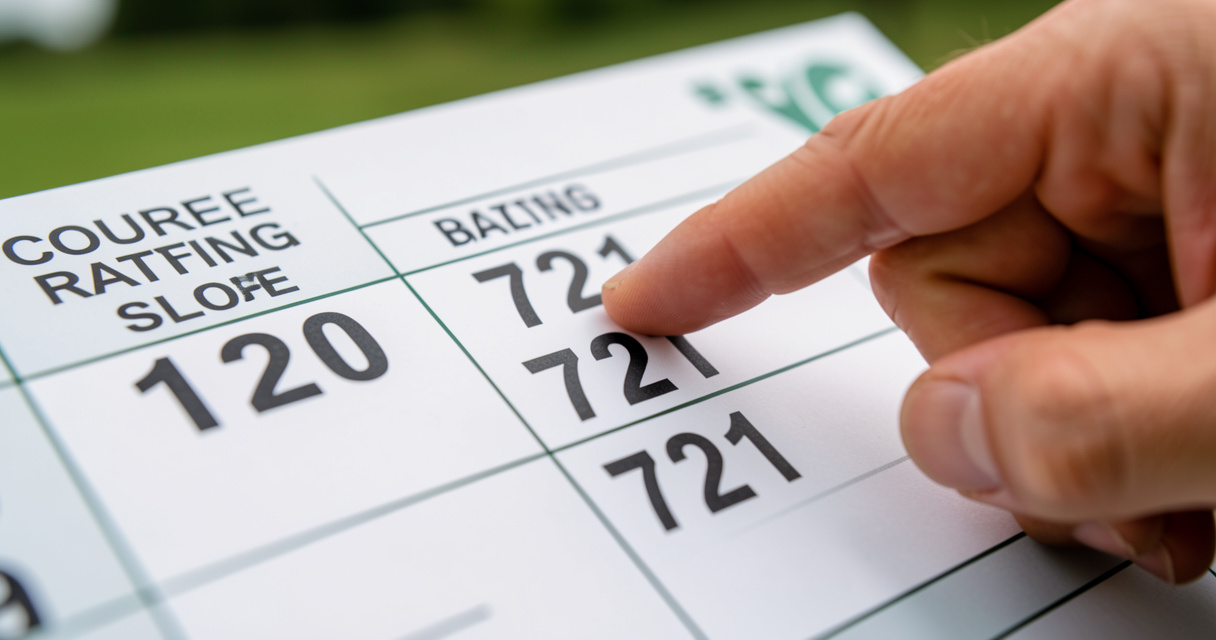
Every official scorecard in the US has a rating table. Typically you’ll see columns for men’s and women’s tees. Look for Slope next to Course Rating. For example, the middle tees might show CR 70.2 / Slope 118. Use that to decide which tees to play. If you’re a 15-handicap and see slope 140 from the tips, you’re in for a long day.
Anecdote: A friend of mine always played the back tees — rated CR 75.0, slope 138. He’d shoot 95 and wonder why his handicap went up. When he moved to the whites (CR 71.6, slope 125), his scores dropped six strokes. That’s the power of knowing the numbers. Walk the course. You’ll understand.
Frequently Asked Questions About Average Slope Rating
What is the average slope rating of a golf course?
The average slope rating in the United States is approximately 120, according to the SCGA. However, 113 is used as the standard baseline in handicap calculations.
Is a slope rating of 113 good or bad?
A slope of 113 is neither good nor bad; it is the standard baseline. Courses above 113 are relatively harder for bogey golfers, and those below are easier.
Why is 113 the standard slope rating?
The USGA selected 113 as a neutral benchmark based on historical data. It represents a course where the difficulty for a bogey golfer is exactly proportional to the scratch golfer’s difficulty.
Does a higher slope rating mean a course is harder?
Not necessarily. A higher slope means the course is relatively harder for a bogey golfer compared to a scratch golfer. A scratch golfer might not notice as much difference.
What does a slope rating of 130 mean?
A slope of 130 indicates that the course is significantly more challenging for bogey golfers relative to scratch golfers. A mid-handicapper will likely lose more strokes from trouble.
How often is slope rating updated?
Slope ratings are typically re-evaluated every 10 years or when major course changes occur (new tees, bunker renovations, vegetation changes).
Conclusion: What the Numbers Mean for Your Game
So here’s the takeaway: slope rating measures relative difficulty for bogey golfers vs. scratch golfers, not absolute difficulty. The USGA uses 113 as the standard baseline for handicap calculations, but the average slope in the US is about 120. Slope is just one part of the picture — always consider both Course Rating and Slope to gauge a course’s challenge. Knowing your course’s slope helps you select the right tee box and understand how your handicap translates.
Next time you pick up a scorecard, make a habit of checking both the course rating and slope numbers — they might change how you approach your round. As I’ve learned from thirty-six years of walking the fairways, the game doesn’t owe you anything. But it does give you the data to play smarter.

Playing golf since before GPS rangefinders existed. Eddie covers the classic game — courses, technique, and the stories worth keeping.