


Reading time: 18 min
Key Takeaways
- Smart decision-making can save you 5–10 strokes per round without changing your swing.
- The DECADE system provides a proven framework for target selection based on your typical dispersion.
- Course operators who focus on pace of play and risk management boost revenue and player satisfaction.
- Green maintenance directly impacts repeat visits and overall reputation.
The Psychology of Smarter Golf Course Management
In 2020, 14% more rounds of golf were played than the year before – the biggest single-year increase since Tiger Woods turned pro. But here’s the catch: the players who improved the most didn’t just swing harder, they learned to manage their game around the course. That’s the difference between a 95 and an 85: not talent, but golf course management. I’ve seen it a thousand times – a guy with a beautiful swing but zero strategy shoots 92, while a scrappy player with decent course management breaks 80. The game doesn’t owe you anything; you have to think your way around the layout.
Understanding Your Misses
The most important part of golf course strategy is knowing your typical miss. If you tend to fade, your miss is right. If you draw, left. Bobby Jones figured this out in 1928: align to where the miss still gives you a playable shot. I can’t tell you how many rounds I’ve seen ruined because a player aimed at a left pin with a fade – ending up in the hazard. Here’s the thing nobody talks about: your swing doesn’t care about your target – it produces what it produces. So aim to make your worst shot still okay.
The ‘Best Miss’ Concept
Suppose there’s water left and bunkers right. Your typical miss is right – so you aim left enough that a straight shot avoids water and a small miss clears the bunkers. That’s the “best miss.” I played a hole like that last week: 430-yard par-4, water left, OB right. My fade made right miss deadly, so I aimed at the left center of the fairway. Miss left = wet? Yes, but my miss is right, so it worked. I made par. A buddy who aimed straight shot after shot in the water finished with a quad. Same skill, different course management.
Pro tip: Always aim for the best miss – avoid bunkers on your miss side. For example, on a hole with water left and bunkers right, if your typical miss is right, aim left center of the fairway. A straight shot stays dry, and a small fade might catch the bunker edge but avoid the water.
Emotional Control vs. Smart Play
Tiger Woods won his fifth Masters in 2019 by playing conservatively and rarely short-siding himself. He once said, “I swing aggressively to my targets, which happen to be on the conservative side.” That’s the heart of emotional control: accepting a bogey when the hero shot is tempting. I’ve lost more rounds trying to save par from a bad position than by simply taking my medicine. How do I think my way around the golf course? I ask myself before every shot: “What’s the smartest play that still gives me a chance at par?” The answer is rarely the risky one.
Transition: Once you master the mental framework, the next step is applying it from the tee box – where most penalty strokes happen.

Tee Box Strategy: How to Avoid Penalty Strokes
- Know your typical miss. If you fade, aim left edge of fairway.
- Choose the widest part of the fairway as your target.
- Club down if driver is inconsistent.
- Avoid trouble on the side of your miss.
- Prioritize having a full (not awkward) approach shot.
That’s the golf pre-shot routine for every tee shot. I see so many players – especially weekend golfers – pulling driver on a tight hole with water right and OB left, then wondering why they lose balls. The data doesn’t lie: the majority of double bogeys start with a penalty stroke off the tee. If you’re a high handicap, club down to a club you know puts the ball in play 8 out of 10 times. That’s not a tip – that’s a truth.
Choosing the Right Club
How to stop hitting into hazards from the tee? Start by asking: “What club gives me the widest landing area and leaves me with a comfortable second shot?” If driver gives you 50% of fairway, but 3-wood gives you 75%, hit the 3-wood. I played a round last month where every hole I hit 4-iron off the tee – shot 76, lost no balls. My playing partner insisted on driver and lost five balls. Best golf course management tips for beginners? Leave the driver in the bag until you can hit it straight consistently.
Aligning to Your Typical Shot Shape
Set up so your starting line is aimed at the side of the fairway opposite your miss. If you hook, aim right edge. If you slice, aim left edge. Sounds simple, but I’ve watched players aim dead center with a slice and wonder why they’re in the right rough every time. Walk the course – you’ll see exactly where your ball will end up.
Pre-Shot Routine Checklist
- Visualize the shot – see the ball flight and landing.
- Pick a specific target – not “center,” but a particular tree or spot.
- One practice swing to feel the tempo.
- Step in and grip – align to your target.
- Pull the trigger – no second thoughts.
Transition: A great tee shot sets you up for the approach – but only if you choose the right target and club.
Approach Shots and Target Selection: The DECADE Method
What is the DECADE golf system? It stands for Distance, Expectation, Correction, Angle, Decision, Execution – a statistically grounded system developed by Scott Fawcett. I was skeptical at first (I’m not a fan of techy systems), but after testing it on the course, I dropped three strokes in two rounds. The idea is simple: aim for the part of the green where your typical dispersion pattern gives you the highest probability of hitting the green and leaving a makeable putt.
Aiming for the Widest Part of the Green
How do I choose where to aim on approach shots? DECADE says: from 150 yards and out, aim for the center of the green. Yes, even if the flag is tucked. Here’s why – the average 10-handicap’s dispersion from 150 yards is about 40 feet left to right. If you aim at a right pin, your miss right goes into the bunker. Aim center, and your miss left or right still catches the putting surface. I’ve played that shot a thousand times – the difference between a tap-in par and a double bogey. Course management isn’t sexy, but it works.
Using Dispersion Patterns
Track your last 10 approach shots with each club. Notice a pattern? Most players have a bias – left or right, short or long. Use that data. If your 7-iron tends to be 10 yards left, aim 10 yards right of the pin. That’s what DECADE calls correction. The system has helped players drop 3–5 strokes per round simply by choosing smarter targets. No swing change required.
When to Go for the Flag
| Condition | Go for Pin | Aim for Center |
|---|---|---|
| Pin location | Front, no hazard short | Back, near bunker or water |
| Hazard carry | Clear, 150+ to pin | Evergreen hazard in front |
| Lie | Perfect fairway | Tight lie, rough, uphill |
| Skill level | Single-digit handicap | Mid to high handicap |
Transition: Once you’re on or around the green, the same principles apply – but the shot options change.
Short Game Management: Getting Up and Down More Often
60% of shots are taken inside 100 yards. Yet most players waste strokes by trying the hero flop when a simple bump-and-run would do. I’ve played that shot a thousand times – from a tight lie 30 yards from the green, the lob wedge is the worst choice. A 7-iron bump-and-run will get you closer to the hole with less risk. That’s how I improve my up and downs: choose the shot that minimizes the distance between the ball and the hole, not the highest trajectory.
Club Selection on Chips
Use the club that gives you the most predictable rollout. From a clean lie with no obstacles, a 9-iron or 8-iron bump-and-run is often better than a sand wedge. For higher handicaps, this is the best golf course management tip you’ve ever heard: practice the bump-and-run from 30 yards and you’ll save 5 strokes a round. I saw a guy at my club who couldn’t break 90 – he switched to bump-and-run only and shot 84 the next week. No joke.
Reading the Bounce
Bounce is your friend. On a tight lie, a low-bounce wedge (4-6 degrees) lets you get the leading edge under the ball. On fluffy rough, high bounce (10-14 degrees) prevents digging. Too many players use the same wedge for every lie. Walk the course and feel the turf before you choose. The golf course strategy behind good short game is simple: match the club to the condition.
When to Lay Up vs. Go for the Green
Sometimes the smart play is to lay up to a full wedge distance instead of trying to carry a bunker from a bad lie. I’ve lost more rounds trying to be a hero than I care to admit. The best par save is often a bump-and-run to the center of the green, leaving a 15-foot putt. Accept that the result is a two-putt bogey, not a par. The game doesn’t owe you anything – play the percentages.
Transition: So far we’ve focused on the player. But course management isn’t just for golfers – operators face their own challenges, especially with risk and pace.
Risk Management for Golf Course Operators (Business)
In 2020, 14% more rounds of golf were played than in 2019 – the most significant one-year increase since 1997, according to Golf Digest (2021). That surge brought more revenue but also more liability. If you’re running a course, golf risk management is not optional. I’ve seen courses lose their insurance because they neglected cart path repairs. Here’s how to manage risk on a golf course for business owners…
Safety Inspections and Hazard Repair
Conduct weekly inspections of cart paths, bridges, and water hazards. Log every issue and fix it within 48 hours. A single lawsuit from a broken ankle can wipe out a year’s profit. Warning: Never mow greens when wet – not only does it compact the soil, but it also increases the risk of slips for your crew. Train your staff on proper equipment use and require PPE. The biggest operational risks are preventable: poor signage near hazards, unsecured chemicals, and unmarked drop zones.
Employee Training and PPE
Every employee should be trained on equipment operation, chemical handling, and emergency procedures. According to the GCSAA, courses with comprehensive safety programs have 40% fewer incidents. Provide gloves, eye protection, and sun gear. Don’t cut corners – one accident can destroy your reputation. The best golf club management tips include a written safety manual reviewed quarterly.
Weather and Seasonal Preparedness
Have a clear lightning policy: sound the horn when storms are within 5 miles. Post it at the first tee and in the pro shop. Train marshals to enforce it. Also, prepare for ice and heat – keep water stations on the course and have a heat illness response plan. Golf course operations that ignore weather safety are asking for trouble.
10-Point Golf Course Risk Audit Checklist:
- Inspect all cart paths for cracks and holes.
- Secure all chemical storage and lock pesticide cabinets.
- Post lightning safety signs at every tee box.
- Test irrigation system for leaks that create slippery areas.
- Mark all water hazards with buoys or ropes where needed.
- Train staff on first aid and AED locations.
- Maintain clear signage for drop zones and OB.
- Ensure all mowers have rollover protection and seat belts.
- Review insurance coverage annually with a broker.
- Conduct a monthly walkthrough with the superintendent.
Transition: Risk management protects your business, but the heart of any course is the quality of the greens – that’s what brings players back.
Keeping Your Greens in Championship Condition
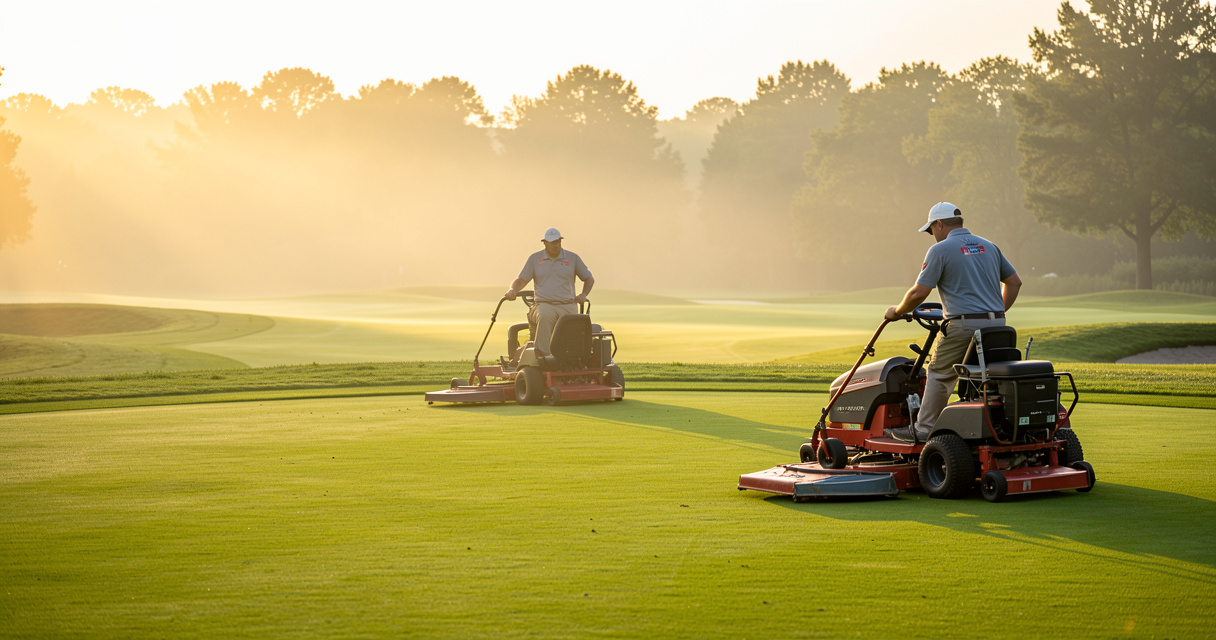
How often should golf greens be mowed? Ideally 6-7 days per week during the growing season using hand mowers for the best quality. At minimum, three times per week to maintain consistent speed. I’ve played courses where the greens were bumpy and slow – and I never went back. The golf course maintenance tips that matter most are about consistency, not perfection. Players notice when greens are fast, true, and healthy.
Mowing Patterns and Frequency
Alternate mowing patterns daily – vertical, diagonal, horizontal – to prevent grain and encourage upright growth. Hand-mowing with a walking mower provides the cleanest cut and reduces stress on the turf. For best results, mow early in the morning when the grass is dry and the dew is gone. Never mow when wet to avoid compaction and disease spread. A strict schedule is non-negotiable if you want championship conditions.
Dealing with Disease and Pests
Dollar spot, anthracnose, and annual bluegrass weevil are common threats. Apply fungicides preventatively based on local weather data. Use integrated pest management – scout daily, treat only when threshold is reached. Overwatering creates disease; under-watering stresses the plant. The best defense is a healthy turf that can resist invaders. Consult your local agronomist or GCSAA resources for region-specific advice.
Balancing Playability and Health
Green speed is a balance between cutting height and moisture. A stimpmeter reading of 10-11 is ideal for daily play – anything above 12 sacrifices turf health. Roll the greens if needed, but don’t overdo it. Aerate every 4-6 weeks during peak season to relieve compaction. Hand-mowing plus careful fertility produces the best playing conditions. Golf course management for operators means listening to both the golfer and the agronomist.
Transition: Great greens attract players, but if they have to wait 5 hours to finish, they won’t come back. That’s where pace of play comes in.
Pace of Play: The Secret to Happy Golfers and Higher Revenue
Slow play is the #1 complaint at golf courses. I’ve walked off the 17th green fuming because a foursome ahead of us took 5:20. How to improve pace of play golf? For players, it’s ready golf: hit when you’re ready, not when it’s your turn. For operators, it’s smarter scheduling and enforcement. A course that turns groups every 4 hours instead of 5 can add 20% more rounds per day – that’s direct revenue growth.
For Players: Ready Golf and Course Etiquette
If you’re playing with a group, always be ready to hit when it’s – or isn’t – your turn. Walk to your ball quickly, have your club selected before you arrive. Limit pre-shot routine to 30 seconds. If you lose a ball, play a provisional. Don’t wait for the green to clear on par-3s if you can’t reach it. These simple habits can shave 30 minutes off a round. The best golf course management tips for high handicap include learning to play quickly without rushing – it improves focus, too.
For Operators: Technology and Staffing Solutions
Use tee time intervals of 8-10 minutes instead of 12. Implement GPS on carts to monitor pace and alert marshals when a group falls behind. Post pace-of-play guidelines on the scorecard and the first tee. Hire marshals who are empowered to ask slow groups to pick it up. I’ve seen courses that reduced average round time by 40 minutes simply by enforcing a 4:15 pace policy. That’s not a tip – that’s a truth: faster play = more rounds = more revenue.
Measuring and Enforcing Pace
| Player Skill Level | Target Time per Hole | Recommended Tee Interval |
|---|---|---|
| Scratch/Low Handicap | 12 min | 8 min |
| Mid Handicap (10-18) | 14 min | 9 min |
| High Handicap (19+) | 16 min | 10 min |
Use these benchmarks to set expectations. If a group exceeds the target on three consecutive holes, send a marshal. Most players respond well to a friendly reminder. The key is consistency – enforce it every day, not just during peak season.
Transition: From tee to green, and from the pro shop to the maintenance shed, smart management is the common thread. Now let’s wrap up with the key takeaways.
Frequently Asked Questions
What is the best golf course management tip you’ve ever heard?
The most upvoted tip from Reddit and pros: “Aim for the best miss” – know your typical miss and set up to avoid hazards on that side.
How do I lower my handicap using course management?
Focus on minimizing big numbers. Use a pre-shot routine, aim for the center of the green outside 150 yards, and accept bogeys without compounding errors.
What is the DECADE golf system?
DECADE stands for Distance, Expectation, Correction, Angle, Decision, Execution – a statistically-based method for shot selection developed by Scott Fawcett.
How to manage risk on a golf course for business owners?
Conduct regular safety inspections, train staff on equipment handling, implement pesticide safety, and maintain clear pathways and signage to reduce liability.
What are the most important aspects of golf course management for beginners?
Beginners should focus on club selection off the tee (use hybrids/irons), aiming for the widest part of the fairway, and avoiding hero shots from trouble.
How to improve pace of play on a golf course?
Encourage ready golf, reduce tee time intervals to 8-10 minutes, use GPS on carts to monitor speed, and enforce marshals.
How often should golf greens be mowed?
Ideally 6-7 days per week during growing season using hand mowers for best quality, but at minimum 3 times per week to maintain consistent speed.
Conclusion: Your Next Move
Let’s recap the key points:
- Master the psychology of golf course management by knowing your misses and accepting bogey.
- Use a pre-shot routine and aim conservatively from tee to green.
- For operators, golf risk management and pace of play are essential to profitability.
- Consistent green maintenance directly impacts player satisfaction and retention.
Whether you’re a weekend golfer or a course manager, the path to lower scores and higher profits starts with smarter decisions – so what will you change first? I’ve watched players and clubs transform just by adopting a few of these principles. Walk the course. Think your way around. The game doesn’t owe you anything, but it rewards those who play it wisely.

Playing golf since before GPS rangefinders existed. Eddie covers the classic game — courses, technique, and the stories worth keeping.