

Reading time: 22 min
Key takeaways
- Alister MacKenzie was a Yorkshire surgeon turned golf course architect who designed more than 50 layouts across four continents between 1907 and 1934.
- Camouflage is the through-line. His Boer War and World War I camouflage work became a repeatable design method: false fronts, buried bunkers, greens that read flat and break hard.
- Three of his courses — Augusta National, Cypress Point and Royal Melbourne West — remain in the Golf Digest top 10 in the world (2022, the most recent verifiable list as of November 2026).
- You can play more of them than you think. Haggin Oaks, Sharp Park, Pasatiempo and Alwoodley are all accessible to a travelling golfer with a phone call and some manners.
Here’s the thing nobody talks about: the man who designed Augusta National never won a major championship. He never played in one. He trained as a surgeon, treated soldiers in the Boer War, spent the First World War hiding gun emplacements from the sky, and only got around to drawing fairways in his late thirties.
His name was Alister MacKenzie. By the time he died in January 1934 he had produced more than 50 courses on four continents, and three of them still sit inside the Golf Digest top 10 in the world (2022 ranking, cited with its year because it remains the most recent verifiable list available as of November 2026). No other golf course architect of his generation has that hit rate at the top of the game.
And yet most golfers can name exactly one of his courses. Ask them what makes a MacKenzie hole feel different underfoot — the false front that swallows a perfectly decent shot, the bunker that looks ten yards closer than it is, the green that reads flat and breaks two cups — and the conversation stops dead.
That is the gap this piece fills: a sourced, structured, playable guide to the man, his method, and the courses you can actually walk. I have stood on enough of his greens to know the feeling. You hit what looks like the right shot, you walk up, and your ball is twenty feet below the hole on a slope you never saw from the fairway. That is not bad luck. That is design, and once you can spot it, you cannot unsee it.
Who Was Alister MacKenzie? The Surgeon Who Reshaped Golf
Alister MacKenzie (30 August 1870 to 6 January 1934) was a British golf course architect who trained as a surgeon and served as a civilian physician in the Boer War. He designed more than 50 courses across four continents, including Augusta National, Cypress Point and Royal Melbourne West, and is a member of the World Golf Hall of Fame.
That is the short version, and it is worth holding onto, because almost everything else about his method grows out of it. He came to golf architecture as a grown man with a medical degree, a war behind him and a genuine sympathy for the player who cannot hit the ball 250 yards.
From Yorkshire Surgery to the Fairways
MacKenzie was born in Normanton, Yorkshire, on 30 August 1870, into a family of Scottish descent. He studied medicine at Cambridge and later at Leeds, then worked as a general practitioner. Golf was the hobby, not the career. He was a member at Alwoodley before Alwoodley had a course worth the name, and like a lot of thoughtful amateurs of that era, he spent more time arguing about the shape of holes than practising his putting.
What pushed him from arguing to drawing was the Lido Prize in 1914 — a design competition run by Country Life magazine asking readers to lay out a golf hole on a given piece of ground. MacKenzie won it. The prize did for him roughly what a published essay does for a young writer: it proved the thing he had been doing in his head for years had value to other people.
His first full course, Alwoodley in Leeds, opened in 1907, per National Club Golfer. That date matters more than any other in this article, because Alwoodley is still sitting there, largely untouched, and it is the cleanest surviving specimen of what he believed before fame got in the way.
War, Camouflage and the Birth of a Designer
Here is the part competitors skip. MacKenzie served as a civilian physician during the Boer War in South Africa, and in the First World War he worked on camouflage — the concealment and disguise of installations, the business of making a thing look like something else, or like nothing at all.
Read that again and then look at a MacKenzie green. He spent years learning that a shape can lie about its own size, that a false surface can pull the eye away from the true target, that the most effective deception is the one that looks entirely natural.
Bobby Jones figured out the value of it later. MacKenzie had it in his hands before he ever drew a bunker in anger.
A Self-Described Mediocre Ball Striker
MacKenzie was candid about his own game in a way that most architects of his era were not. He called himself a good putter and a middling ball striker — the kind of player who keeps score with his head and his hands rather than his driver.
Late in life, after moving to California for the work and the climate, he wrote that his ball striking improved past sixty, and that he was scoring in the 70s in California. That anecdote is not vanity. It is a design brief. A man who improves after sixty believes courses should reward the player who is getting better, not punish the player who never got good.
That is not a tip — that is a truth. And it explains why his courses forgive you in places where other architects bury you.
| Year | Milestone | Location | Why it matters |
|---|---|---|---|
| 1870 | Born, 30 August | Normanton, Yorkshire | Yorkshire becomes the root of his design language |
| 1907 | First course opens | Alwoodley, Leeds | The purest surviving example of his early thinking |
| 1914 | Wins the Lido Prize | Country Life competition | Establishes him as a design thinker, not just a member |
| 1920 | Publishes Golf Architecture | London | First proper text on the fundamentals of design |
| 1923 | Surveys the Old Course for the R&A | St Andrews | His map still hangs in the clubhouse |
| 1928 | Cypress Point opens | California | Deception meets coastline at full scale |
| 1934 | Dies, 6 January | Santa Cruz, California | Never saw the first Masters played |
Once you see that timeline laid out, the next question is obvious: what did that strange combination of medicine, camouflage and honest self-assessment actually produce on the ground?
The Design Philosophy: Camouflage, Deception and Nature
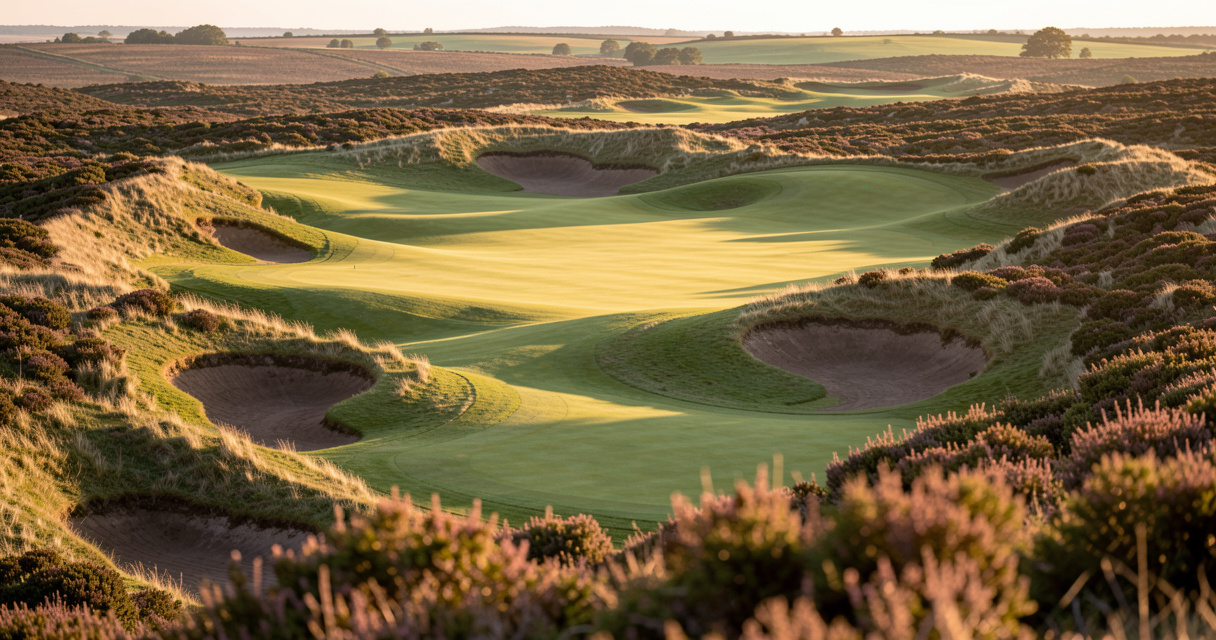
Alister MacKenzie design principles all trace back to one idea: a golf hole should look like it was found rather than built, and it should never tell you the truth at first glance. MacKenzie absorbed camouflage technique during the Boer War and applied it in World War I, then translated it into architecture — features that hide their true scale, bunkers that sit closer than they appear, greens that read flat and break hard, and naturalistic tie-ins that disguise how much earth was moved.
Deception as a Design Tool
MacKenzie wrote that a course should appear to have been created by nature rather than by man. That sentence gets quoted as a romantic gesture. It is actually a technical instruction.
If a green looks like a natural rise in the ground, you stop calculating and start trusting your eye. And your eye, on a MacKenzie hole, is the least reliable instrument in the bag. A bunker lip that blends into the heather hides the fact that the sand is four feet deeper than the ground suggests. A ridge that reads as a gentle swale disguises a green that falls away in two directions.
I have played that shot a thousand times: the approach that looks like a stock eight iron, struck well, landing exactly where I aimed, and then running off a false front into a collection area I did not know existed. That is not unfair. That is a camouflage officer doing his job thirty years after the war ended.
Definition: MacKenzie’s camouflage approach means designing hazards and contours whose difficulty is deliberately misread at a glance. The point is not to trick the player out of a good score — it is to reward the player who looks twice.
Greens That Look Flat and Break Hard
Stand behind a MacKenzie green and it can look like a table. Walk onto it and your feet tell a different story. The contouring is often broad and shallow rather than sharp and obvious, which means the break accumulates over the whole twenty feet instead of showing itself in the first three.
He hated flattening natural undulations. Where a lesser architect would have graded a green to make putting “fair”, he left the ground alone and let the player solve it. That is why his greens age so well: they were never smoothed into submission in the first place.
The practical consequence is brutal and simple. A putt that looks like it breaks one cup breaks three. A putt that looks straight is not straight.
Width, Angles and Risk Versus Reward
MacKenzie’s fairways are famously wide, and a lot of players read that as permission. It is not. Width is there to offer multiple angles of attack — a safe corridor and a bold one — and the bold one always shortens the hole and opens the green.
The risk-reward par fives at Augusta are the famous expression of this, but the principle is everywhere. Take the aggressive line and you get a wedge and a look at birdie. Take the safe line and you get a long iron into a green that will not hold it. The course never stops you. It just charges you for the choice.
Walk the course. You will understand. The angles reveal themselves on foot, from behind the tee and beside the green, not from a cart path.
- False front — a green edge that slopes away from you and rejects anything short
- Tucked bunker — sand hidden behind a rise, closer than it reads
- Deceptive green contour — broad, shallow, cumulative break
- Wide playing corridor — space for two or three distinct lines
- Multiple angles of attack — the bold line shortens the hole
- Natural tie-ins — no visible earthwork, no obvious construction
That philosophy produced a body of work spread across four continents, so the sensible next step is a list you can actually use — organised by region, with access stated honestly.
Every Alister MacKenzie Golf Course: The Complete List by Region
MacKenzie designed more than 50 golf courses across four continents between 1907 and the early 1930s, according to the Alister MacKenzie Society and Wikipedia. The count varies between sources because some layouts were collaborations, some were modifications of existing courses, and several have been remodelled so heavily that the original hand is hard to trace.
So treat the list below as a working reference, not scripture. Where the attribution is disputed, I say so. Where you can book a tee time, I say that too — because an Alister MacKenzie golf course you cannot walk is only half a course.
Great Britain and Ireland
This is where it started and, for my money, where the purest work survives. Yorkshire alone holds a cluster of MacKenzie layouts built between 1907 and the early 1920s: Alwoodley, Moortown, Headingley, Sandmoor and Ilkley. Add Fulford in York, Sitwell Park near Rotherham and Kedleston Park in Derbyshire, and you have a fortnight’s pilgrimage within two hours of Leeds.
In Ireland, his 1924 modifications and extensions at Douglas Golf Club near Cork were praised at the time for bearing “the impress of his golfing genius,” and his later work at Lahinch and Cork Golf Club at Little Island keeps him in the conversation on the southwest coast.
United States and Canada
California holds the mother lode. Cypress Point (1928), Pasatiempo (1929), the Meadow Club, Green Hills, Lake Merced, the California Golf Club, the Valley Club of Montecito and the public layouts at Sharp Park and Haggin Oaks. Michigan has Crystal Downs, built with Perry Maxwell, which many architects rate as the most underrated course in America.
Augusta National closes the American chapter in the early 1930s. A handful of Canadian attributions circulate, and most of them are thin — collaborations, advice, or work later rebuilt beyond recognition. Verify before you book a flight.
Australia, New Zealand and South America
Royal Melbourne’s West Course is the headline, but MacKenzie’s Australian footprint is wider than one course: Royal Melbourne East, Victoria, Metropolitan and a consultation at Kingston Heath. In New Zealand, Titirangi outside Auckland carries his name and a genuinely difficult set of greens. His South American commissions, concentrated around Buenos Aires in the late 1920s and early 1930s, remain the least documented part of the catalogue.
| Course | Country | Year opened or redesigned | Access |
|---|---|---|---|
| Alwoodley | England | 1907 | Private, visitor days |
| Moortown | England | 1909 | Private, visitor days |
| Sitwell Park | England | c. 1912 | Private, by arrangement |
| Kedleston Park | England | 1920s | Private, by arrangement |
| Douglas | Ireland | 1924 modifications | Private, visitor welcome |
| Lahinch | Ireland | 1927 alterations | Resort, public |
| Cork (Little Island) | Ireland | 1927 | Private, visitor days |
| Cypress Point | USA | 1928 | Strictly private |
| Pasatiempo | USA | 1929 | Semi-private, bookable |
| Meadow Club | USA | 1927 | Private, by arrangement |
| Crystal Downs | USA | 1929 to 1931 | Private, member hosted |
| Sharp Park | USA | 1932 | Public |
| Haggin Oaks | USA | 1932 | Public |
| Augusta National | USA | 1933 | Strictly private |
| Royal Melbourne West | Australia | 1926 | Private, visitor days |
| Kingston Heath | Australia | 1925 consultation | Private, visitor days |
| Titirangi | New Zealand | 1927 | Private, visitor days |
Lists are useful. Holes are better. Three of these courses contain the clearest demonstrations of the method in the world, and they are worth walking one at a time.
The Masterpieces: Augusta National, Cypress Point and Royal Melbourne
Three of MacKenzie’s designs remain in the Golf Digest top 10 courses in the world: Augusta National, Cypress Point and Royal Melbourne West — a fact cited with the 2022 ranking year because that is the most recent verifiable list as of November 2026. The Alister MacKenzie Society reported the same trio in the top 10 of the corresponding ranking back in 2016. Consistency across a decade is the point.
Augusta National: A Partnership With Bobby Jones
Augusta National Golf Club was designed with Bobby Jones in the early 1930s on the site of a plant nursery in Georgia, and it has hosted the Masters every April since 1934. Jones chose MacKenzie after playing Cypress Point and recognising a shared obsession: the Old Course at St Andrews, its width, its angles, and the way it lets a thoughtful player find a route home.
The risk-reward par fives are the living expression of that conversation. Two of them invite a decision on the second shot that can win you the tournament or end your week. MacKenzie never saw it played. He died on 6 January 1934, months before the first Masters.
Cypress Point: Marion Hollins and the 16th
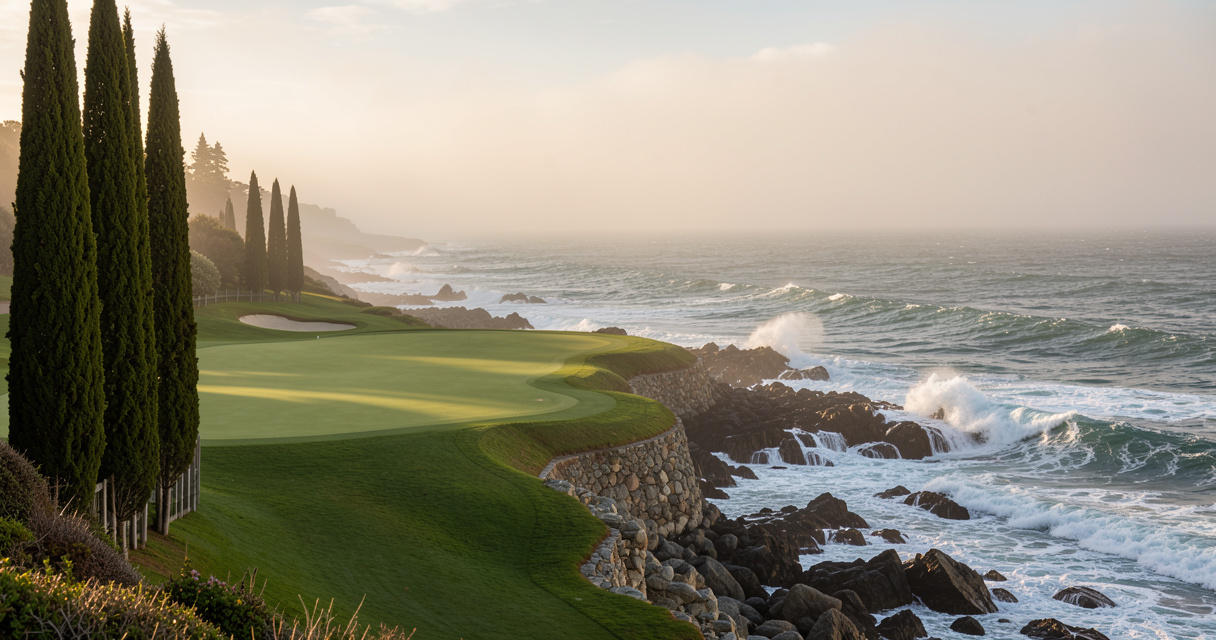
Cypress Point Club opened in 1928, and its par-3 16th over the Pacific has been called the most photogenic hole in the world. It almost did not exist in that form.
MacKenzie wanted a do-or-die par four across the water. Marion Hollins — the driving force behind the project and one of the most underrated figures in American golf — argued that a short hole carried the same drama without the carnage, and won the argument. His response, in essence, was that the thrill of the carry was worth a dozen lost balls. She was right. He knew it.
Stand on that tee and you feel exactly what he was chasing: a shot that scares you and rewards you in the same breath. That is not a gimmick. That is the whole game in one swing.
Royal Melbourne West: The Southern Masterpiece
Royal Melbourne’s West Course, laid out in the 1920s on the sandbelt south of the city, completes the trio. Its bunkering is the most aggressive of the three, cut hard into the faces of the ridges rather than floated on top, and the greens sit on natural sandy rises that drain and run like few others on earth.
Australian architects have been studying it for a century. Alister MacKenzie golf courses like this one are why the sandbelt became a design school in its own right.
| Course | Country | Year opened | Signature feature | Ranking status |
|---|---|---|---|---|
| Augusta National | USA | 1933 | Risk-reward par fives | Top 10, Golf Digest 2022 |
| Cypress Point | USA | 1928 | Par-3 16th over the ocean | Top 10, Golf Digest 2022 |
| Royal Melbourne West | Australia | 1926 | Sandbelt bunkering | Top 10, Golf Digest 2022 |
| Pasatiempo | USA | 1929 | Barranca and bold green contours | Highly rated, bookable |
| Crystal Downs | USA | 1929 to 1931 | Rolling Michigan ground, tiny greens | Cult favourite |
The famous work gets the plane tickets. The British work gets the credit. So before we come back to the present, let us go back to Leeds, because that is where the method was invented.
MacKenzie in Great Britain and Ireland: From Alwoodley Outward
Alwoodley Golf Club, founded on the edge of Leeds in 1907, was MacKenzie’s first layout and remains largely untouched. That combination — first and unaltered — makes it the purest surviving example of his ideas anywhere in the world, and the single most important stop on any MacKenzie itinerary.
Alwoodley, 1907: The Blueprint
What you notice at Alwoodley is how little you notice. There are no dramatic carries, no manufactured ponds, no signature flourishes shouting the architect’s name. The heathland rolls, the bunkers are cut into the slopes rather than piled onto them, and the greens sit on natural shelves where the ground already wanted to go.
That restraint is the whole point. He was not building a monument. He was finding a golf course inside a piece of land that was already shaped for one. The Alister MacKenzie golf course at Alwoodley is what his entire portfolio would look like if nobody had ever asked him to make a course more difficult for a major championship.
Ci-dessous les blocs Gutenberg manquants, à intégrer directement après le paragraphe de transition existant du chapitre « MacKenzie in Great Britain and Ireland ». Le titre cassé `The English County Trail` est repris proprement en ouverture. “`htmlThe English County Trail
From Leeds the work radiates outward across a line of county clubs that still anchor his British reputation. Moortown opened in 1909 and hosted the first Ryder Cup played on British soil in 1929. Headingley, Sandmoor and Ilkley fill out the Yorkshire cluster inside a thirty-minute drive of Alwoodley. Fulford in York, Sitwell Park near Rotherham and Kedleston Park in Derbyshire stretch the trail east and south. The pattern repeats at every stop: heathland and parkland sites with natural movement in the ground, wide playing corridors and bunkers cut into existing slopes rather than piled on top of them. You can drive the whole circuit in a long weekend, and every course teaches the same lesson about restraint.
Ireland and the Douglas Redesign
Ireland holds a smaller but equally instructive chapter. His 1924 modifications and extensions at Douglas Golf Club near Cork were praised in print at the time for bearing “the impress of his golfing genius,” and the club still owns the association on its signboard and in its club history. His later alterations at Lahinch in 1927 and his work at Cork Golf Club at Little Island show the same principles applied to links and estuary ground: wide fairways, greens that use the natural fall of the land, and hazards that read closer than they measure. If Yorkshire is where the method was invented, Ireland is where it proved portable.
Planning a MacKenzie pilgrimage in Britain? Start at Alwoodley and secure visitor access by phone or email well in advance — county clubs respond better to a proper introduction than to a walk-in. Play Moortown and Fulford on the same trip, then finish at Sitwell Park if a slot opens. Take a caddie where one is available: the deception reads faster with a local eye, and the greens will tell you things your eyesight cannot.
The British roots explain the method. The book explains the reasoning. Together they tell you why the courses still work a century later, and why the next section matters more than any ranking.
Golf Architecture (1920): What His Book Still Teaches
Golf Architecture, published in London in 1920, was recognised by the World Golf Hall of Fame as the first book to present and explain the fundamentals of golf course design. Reading it in 2026 is a strange experience, because most of what pass for modern design debates are already answered in its pages with more clarity than most current writing manages.
The First Book on Design Fundamentals
He did something no one had done cleanly before. He wrote the rules down. He separated strategic design from penal design and argued, in print, that a course should be enjoyable before it should be hard. He insisted the architect’s job is to reveal a site rather than to impose a plan on it — a position that sounds modern only because most architects ignored it for fifty years.
Designing for Two Golfers at Once
His most-quoted idea — and his most-misused — is that a single hole should challenge the expert and welcome the lesser player on the same swing. He was not talking about dumbing courses down. He was talking about width, multiple routes of attack, and greens that accept a running approach when the air route is closed. That is why his courses still feel playable to a twenty-handicapper on a windy Saturday and still host major championships.
Building Before the Bulldozer
Everything he built was shaped by horses, scoops and hand labour. He could not move fifty thousand cubic yards of earth on a whim. That constraint forced him to work with what the ground offered. Green complexes that had to be tied into existing contours aged better than ones that could be re-shaped at will, and a century later that shows on every surviving MacKenzie layout.
What “the lesser player” meant to MacKenzie: not a beginner, but the competent mid-handicap golfer who plays twice a week and pays the club’s bills. Designing for that player means preserving width, allowing a running shot into the green and refusing to punish a decent swing with a bad bounce.
Legacy in 2026: Why His Courses Still Top the Lists
Golf Digest’s 2022 ranking of the world’s top 100 courses still lists three MacKenzie designs inside the top 10: Augusta National, Cypress Point and Royal Melbourne West. That ranking year is cited explicitly because it remains the most recent verifiable list available as of November 2026. The Alister MacKenzie Society reported the same trio inside the top 10 of the corresponding ranking back in 2016, and the fact that they have not moved in a decade is the point. His courses do not need defending. They need explaining.
Rankings, Restoration and Attribution Debates
The honest version of this story has to include the disputes. Not everything attributed to MacKenzie is solely his. Some layouts were collaborations, some were later rebuilt beyond recognition, and a few were his advice on a site drawn by someone else. The restoration movement has added heat to the argument — see the ongoing debates at Pasatiempo and at Sharp Park — and the Alister MacKenzie Society has done valuable work in documenting attributions, but no single authority has closed the case. Verify before you travel.
The Alister MacKenzie Society Since 1999
The Alister MacKenzie Society was founded in 1999 to celebrate his work as a golf course architect in Great Britain and Ireland through the fellowship of golf. It publishes MacKenzie News, organises outings at his surviving courses and supports research into attributions. It is the single best starting point for anyone who wants to go beyond the famous three, and the most reliable referee in the attribution debates above.
Before you book: course attributions vary between sources, and some layouts were collaborations, remodels or later restorations. The courses listed in this article carry the strongest documented claim, but where an attribution is disputed, verify with the club or with the Alister MacKenzie Society before planning travel.
How to Play a MacKenzie Course: Reading Greens, Angles and Risk
Knowing who designed a course is useless unless it changes what you do on the first tee. Here are the practical habits that convert the camouflage method into a score. None of them are gimmicks, and all of them will work on courses MacKenzie never saw.
Pick the Angle, Not the Yardage
Take the bold line off the tee on the holes where the fairway is wide. The wide fairway is not permission to swing freely — it is an invitation to choose. Aim at the side of the fairway that opens the green. At Alwoodley and at Pasatiempo this often means aiming at a bunker or a ridge rather than at the middle of the short grass, because the middle of the short grass leaves you the wrong angle in. On a MacKenzie hole, position always beats proximity.
Putting on Deceptive Contours
Trust the visible contour but expect more break than it shows. Read the putt from both sides of the hole and from below. If the green reads flat, find the natural drainage and play the break the water would take, not the line your eye prefers. At Crystal Downs and at Royal Melbourne the break accumulates slowly across the whole length of the putt, which means a two-foot left-to-right can become four feet by the hole. Walk the green before you look at the line. Your feet are more honest than your eyes.
- Find the widest corridor from the tee before you choose a line
- Identify the preferred approach angle to the green, not the shortest line to the fairway
- Check for a false front before you commit to a yardage — add five yards whenever you are unsure
- Read the green from both sides and from below the hole before you pick a line
- Commit to the bold line when the corridor is wide — the half-committed shot is the one that finds sand
Frequently Asked Questions
How many golf courses did Alister MacKenzie design?
More than 50, across four continents, between 1907 and the early 1930s. The exact count varies between sources because some layouts were collaborations (Crystal Downs, with Perry Maxwell), some were modifications of existing courses (Lahinch in 1927, Douglas in 1924) and a few have been remodelled so heavily that the original hand is hard to trace. The Alister MacKenzie Society and the World Golf Hall of Fame both use the “more than 50” framing.
What is Alister MacKenzie most famous for?
Augusta National, Cypress Point and Royal Melbourne West. What connects those three isn’t their fame but their method — wide playing corridors, multiple angles of attack, greens that use the natural contours rather than being flattened into submission, and hazards that lie about their distance at first glance.
Was Alister MacKenzie a golfer himself?
He described himself as a good putter but a mediocre ball striker, and said his ball striking actually improved past sixty, when he was scoring in the high 70s and low 80s in California. He never played in a major championship and never won one. That is part of why he designed so carefully for the mid-handicap golfer.
Where was Alister MacKenzie born?
Normanton, Yorkshire, on 30 August 1870. His first course, Alwoodley, was built on the edge of Leeds. He died in Santa Cruz, California, on 6 January 1934.
Did Alister MacKenzie see the first Masters Tournament?
No. He died on 6 January 1934, months before the first Masters was played at Augusta National in March 1934. He never saw the tournament that made his most famous course famous.
Which Alister MacKenzie courses can I actually play?
Haggin Oaks in Sacramento, Sharp Park in Pacifica, Pasatiempo in Santa Cruz, and — with a polite request well in advance — Alwoodley, Moortown and Fulford in the UK, plus Douglas and Cork in Ireland. Augusta National and Cypress Point are strictly private. No letter, however well-mannered, will get you on.
What is the Alister MacKenzie Society?
It was founded in 1999 to celebrate his work as a golf course architect in Great Britain and Ireland through the fellowship of golf. It publishes MacKenzie News, organises outings at surviving courses and supports research into attributions. It is the best single starting point for anyone who wants to go beyond the top three courses.
The Enduring Legacy of Alister MacKenzie’s Golf Course Architecture
The enduring legacy of Alister MacKenzie’s golf course architecture comes down to four things worth carrying off the page. His medical training and his camouflage work in two wars produced a design language built on deception and naturalism — a method, not a style. His body of work spans more than 50 courses across four continents, from Alwoodley in 1907 to Augusta National in the early 1930s. Three of his layouts remain inside the top 10 in the world, a durability most architects would trade their whole portfolio to match. And the playing principles he built into those courses — pick the angle, expect more break than you see, treat width as an invitation rather than permission — still apply on ordinary courses you will play on a Sunday morning.
So which MacKenzie course will you walk next? Alwoodley is where the method began and it is still the most honest test of whether you can spot the deception. Pasatiempo is the one you can actually book. Royal Melbourne and Cypress Point might be once-in-a-lifetime, and that is fine. What matters is what you do when you get there. Now that you know what to look for — the false front, the buried bunker lip, the green that reads flat and breaks hard — the question is whether you will recognise it in time to play the right shot.
The camera sees what MacKenzie built. Only the player on foot sees what he meant.
“`The English County Trail

Playing golf since before GPS rangefinders existed. Eddie covers the classic game — courses, technique, and the stories worth keeping.