

Reading time: 8 min
Key Takeaways
- True links golf on England’s Golf Coast offers fast, firm turf and timeless seaside charm.
- Formby Golf Club, with over 140 years of history, delivers a pure, walkable links experience minus the “Royal” title.
- Rich legends like Maurice Flitcroft and Horus the Hippo add character and remind us golf is as much about stories as scorecards.
England’s Golf Coast: A Step Back in Time
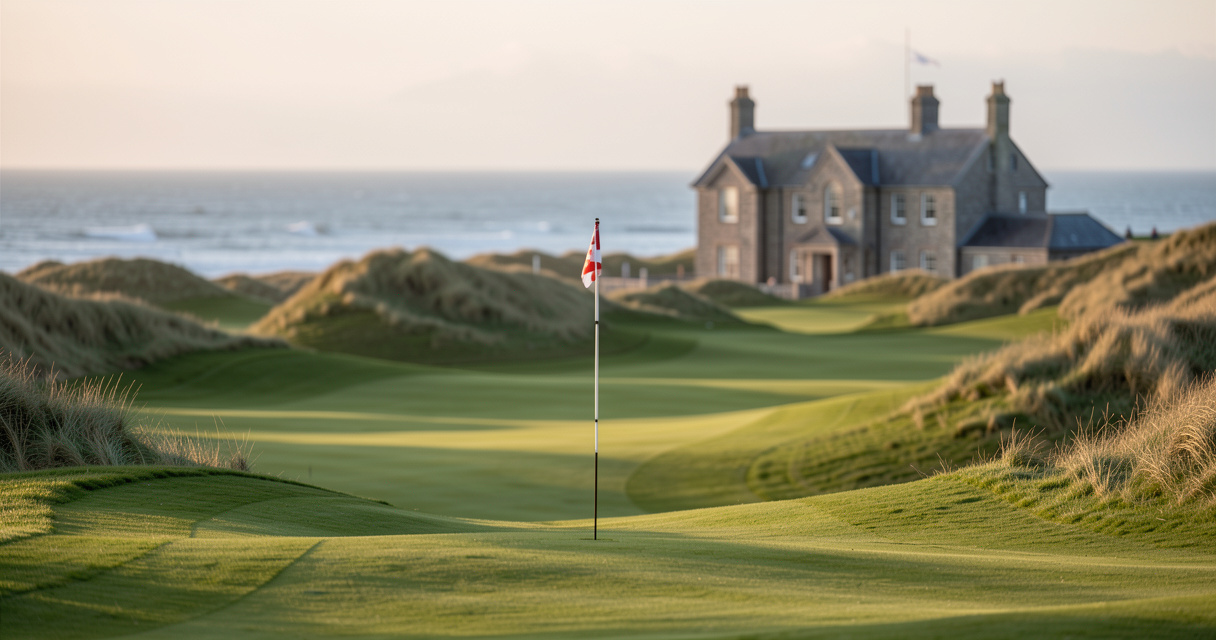
I’ve played my share of links golf, but nothing quite matches the feeling of stepping onto England’s Golf Coast. The Irish Sea laps at the shore, shaggy dunes frame slender fairways, and the wind plays its eternal game of keep-away with your ball. Here’s the thing nobody talks about: when you stand there, you lose all sense of time. The year could be 1926 or 2026 — the game remains the same.
The region, stretching between Liverpool and Manchester, boasts eight seaside links, including three Open venues. Five are consecutive stops on the Merseyside rail line: Royal Birkdale, Hillside, Southport and Ainsdale, West Lancashire, and Formby. And with Royal Liverpool and Wallasey nearby, you’ve got a golfer’s paradise that hasn’t changed in over a century. Walk the course. You’ll understand.
Formby Golf Club: A Jewel Without the Crown
Formby Golf Club, founded in 1884, may lack the “Royal” prefix of its neighbours, but it stands as one of England’s finest links. It has hosted the Amateur Championship four times and the English Amateur five times, along with countless other prestigious events. Only the Open and the Ryder Cup have eluded it — and that’s purely down to logistics. There’s simply no room for 60,000 spectators and a tented city.
But Formby’s history echoes through the centuries in other ways. Some stories don’t need trophies.
The Phantom of the Open: Maurice Flitcroft
Take Maurice Flitcroft, the “Phantom of the Open.” A chain-smoking crane operator from Barrow-in-Furness, Flitcroft fell in love with golf after watching the Open on telly. He had never swung a club, but somehow knew it was his calling. Without a lesson or a clue, he set out to qualify for the 1976 Open at Formby.
Flitcroft would sneak onto private clubs at night to practice until the grounds crew chased him off. He showed up at Formby with mismatched clubs, no golf shoes, and barely a grasp of the rules. Listing himself as an unattached professional, he carded a ghastly 61-60=121. The asterisk? It was written on the scorecard by one of his playing partners, Jim Howard. The R&A banned him for life.
But Flitcroft refused to go quietly. For the next seven years, he entered Open qualifying under absurd fake names — Gene Paychecki, Arnold Palmerston, Beau Jolley — and wore ridiculous disguises. The R&A threw everything at him, even handwriting experts, but he kept sneaking in. Fans loved it. Once, paired with Seve Ballesteros, he got a few holes in before officials caught on. “IT IS FLITCROFT! GET HIM!” they shouted as the bobbies escorted him away while the crowd roared.
Flitcroft’s story became a film, The Phantom of the Open, and in 1988, Blythefield Country Club in Michigan created the Maurice Gerald Flitcroft Member-Guest Tournament. Worst score wins. Bobby Jones figured this out in 1928: the game doesn’t owe you anything, but it sure can give you a story.
Horus the Hippo: Formby’s Unlikely Mascot
Then there’s Horus the Hippo. Back in the late 1880s, Edgar Storey, the club’s 1896 captain, shot a hippopotamus in North Africa. He had the head stuffed, named it after the Egyptian god of light, and mounted it in his home. His wife hated it. When Edgar died in 1909, she graciously donated Horus to Formby Golf Club.
Fast forward to 1941. During World War II, the course was taken over by the Royal Navy. One night, three naval officers, well into their cups, decided to “borrow” Horus as a prank and bring him back to their ship. But before they could return him, their destroyer was sent to the North Sea to hunt U-boats. Horus was strapped to the light tower for luck. The ship survived two torpedo hits, and Horus took a bullet in the teeth — easily mended. When they returned, a stuffy admiral wanted them court-martialed, but the club captain intervened. A letter of apology, and Horus came home a decorated war hero.
In the members’ bar, an owl sits stuffed and mounted. Club historian Ian Jamson explained: “He’s hung there since 1914. The poor thing was hit with the gutta percha ball we mounted in the case along with him. Years ago one club officer didn’t like it and tried to hide it in a broom closet. But I found him and put him back up.”
The Clubhouse and the Course
The clubhouse, opened in 1901 after a fire destroyed the original, is one of three designed by Charles Hutchinson in the area — the others being Royal Lytham and Royal Liverpool. All three feature ornate turrets and balconies. In 1909, Bruce Ismay, owner of the White Star Line (yes, that Ismay, who survived the Titanic by slipping into a lifeboat), gifted the club its prominent clock for its 25th anniversary. One member muttered, “Yes, unfortunately, he survived.”
On the course, Formby is a smashing, scintillating links with three distinct ecosystems: true linksland, mature conifer-covered holes, and rolling heathland. I’ve played that shot a thousand times — the low, running approach that feeds into the green — and it never gets old. Walking this course, you feel the centuries. That’s not a tip — that’s a truth.
Why Formby Matters
In a world of mandatory carts and GPS gadgets, Formby remains a sanctuary. It’s a place where you walk, think, and occasionally argue with yourself over club selection. The game doesn’t owe you anything, but Formby gives you everything: history, beauty, and the chance to step back 150 years. To keep it that way has been British golf’s dearest dream. Formby has succeeded. And for that, we should all be grateful.

Playing golf since before GPS rangefinders existed. Eddie covers the classic game — courses, technique, and the stories worth keeping.