

Reading time: 14 min
Key Takeaways
- MacGregor Tourney irons span eight decades, from 1941 Tommy Armour TMS to 2026’s MACSPD and MT Milled – a lineage unmatched in golf equipment history.
- Vintage MT and R2MT models offer unmatched forged feel but demand low-handicap skills; modern revivals add forgiveness without sacrificing the classic profile.
- Identification is critical – sole stamps, ferrule bands, and serial numbers date each club; counterfeits and re-shafted sets are common in the used market.
- Buying strategy varies by goal: collectors chase rare R2MTs ($500–$800), players on a budget choose used modern sets ($300–$500), and purists pick the MT Milled for pure 1020 carbon steel feel.
History and Evolution of MacGregor Tourney Irons
Did you know that MacGregor’s Tourney irons have been forged by hand since the 1940s, yet in 2026 they’re still among the most underrated irons on the market? That’s the kind of contradiction I love about this game – a brand that defined the golden age of American golf can still turn heads on the first tee. But with dozens of models spanning eight decades, players struggle to separate the gems from the duds when shopping for MacGregor Tourney irons – whether they seek vintage collectibles or modern game-improvement sets. Here’s the thing nobody talks about: the vintage golf clubs market is flooded with fakes and misidentified sets, and the difference between a $200 set and a $700 set often comes down to a single stamp on the sole. Let’s trace the lineage from the first Tourney to the latest forged irons 2026 has to offer.
1940s–1950s: The Golden Era Begins
The first MacGregor Tourney irons rolled out of the Dayton, Ohio factory in 1941, branded as the Tommy Armour Tourney TMS. According to the Swing Yard MacGregor Irons By Year chart (2024), this model featured a classic muscle-back design, forged from a single billet of carbon steel. Toney Penna, MacGregor’s master forger, shaped these heads by hand – no CNC, no computer-aided design. Bobby Jones would have recognized the profile instantly. In the 1950s, the lineup expanded with the Silver Scot and the MT (which stood for ‘Master Touch’), but the core philosophy never changed: a forged blade that rewarded a pure strike like a handshake. I’ve held a 1952 Tourney 2-iron at a garage sale in Ohio, and let me tell you, the feel through the fingers is something no modern cavity back can replicate.
1960s–1970s: The MT Revolution
1968 introduced the MT Tourney MTR1 model – the first to bear the iconic ‘MT’ stamp that collectors hunt today. The MTR1 had a split sole design that reduced drag through the turf, a feature that Hogan himself would later adopt in his own grind. The Swing Yard chart notes that the 1967 R2MT was produced for only one year, making it the rarest of the early MTs. I remember a 1980s golf shop owner telling me that the R2MT was a ‘mistake model’ because the sole grind was too radical – but that mistake is now worth three times what a standard MT sells for. The 1970s brought the VIP Nicklaus line (Jack used them, not the standard Tourney, but the design cues are identical) and the Muirfield model, named after the Scottish links. By the end of the 1970s, MacGregor had produced over 40 distinct Tourney variations, each with subtle changes in offset, blade length, and hosel geometry.
Modern Revival: MACSPD and MT Milled
After a quiet period in the 1990s and early 2000s, MacGregor revived the Tourney nameplate in the 2010s with the MACSPD (foam-filled hollow body) and the MT Milled (forged cavity back). The 2026 lineup includes both, plus the Tour Forged CB for the purist. The MACSPD uses a proprietary foam polymer to damp vibration while maintaining face flexibility – a trick borrowed from driver technology. The MT Milled is forged from 1020 carbon steel, the same material used in the 1940s, but with CNC-milled faces for tighter tolerances. Here’s the thing I respect: MacGregor didn’t slap the Tourney name on a cast club. Everything in their current line is forged, and the MACSPD is still assembled in the USA. That matters.
| Decade | Model Name | Key Feature | Current Value Range |
|---|---|---|---|
| 1940s | Tommy Armour Tourney TMS | Hand-forged muscle back | $200 – $400 |
| 1950s | Silver Scot | Wing back design | $250 – $500 |
| 1960s | MT MTR1 (1968) | Split sole, first MT stamp | $350 – $700 |
| 1960s | R2MT (1967) | One-year production, radical sole | $500 – $800 |
| 1970s | VIP Nicklaus | Designed for Jack, muscle cavity | $300 – $600 |
| 1970s | Muirfield | Classic blade, lower offset | $200 – $450 |
| 2020s–2026 | MACSPD | Foam-filled, distance | $799 new, $400 used |
| 2020s–2026 | MT Milled | Forged 1020 carbon, cavity | $899 new, $500 used |
Note: Values based on 2026 market data from eBay sold listings and collector forums. Condition and original shaft markedly change price.
That historical foundation sets the stage for understanding what you’re actually looking at when you pick up a set. Now let’s decode the most sought-after vintage models.
Key Vintage Models Decoded: MT, R2MT, Muirfield & More
If you’re shopping for MacGregor MT irons on eBay, you need to know the difference between an MT and an R2MT – and fast, because the listing will disappear in three hours. I’ve played that game a thousand times. Here’s the breakdown.
MacGregor MT Tourney (MTR1, MTR2)
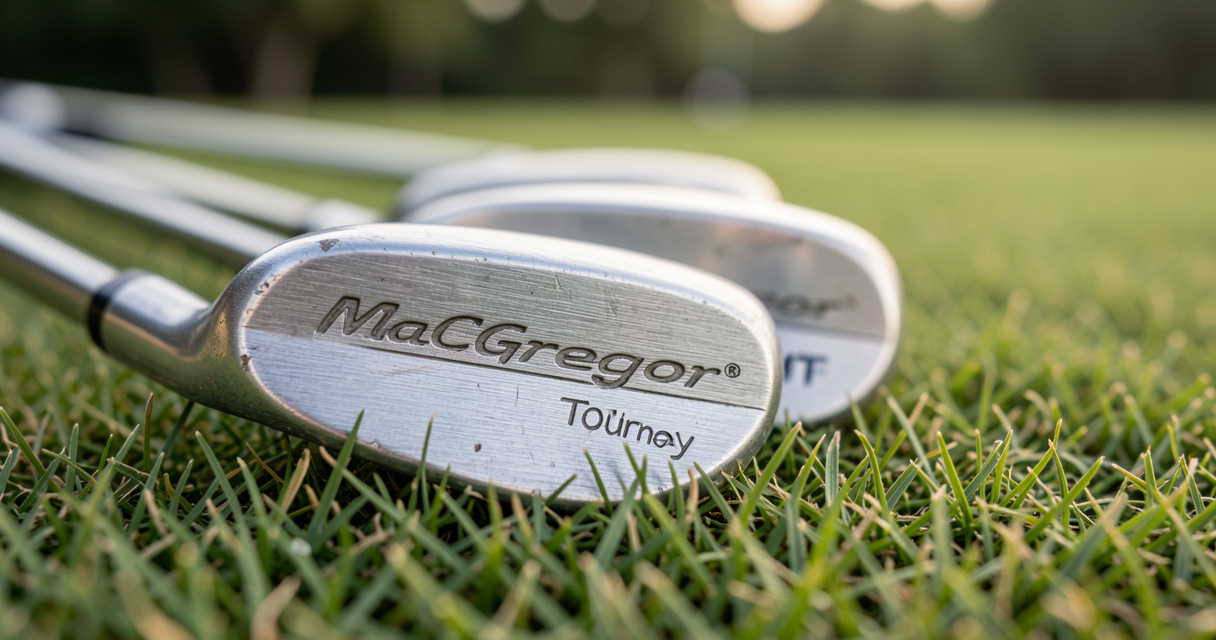
The MT stands for ‘Master Touch’ – a lineage that started in the late 1960s. The MTR1 (1968) has a split sole and a slightly thicker topline than the later MTR2 (1970). The sole stamp reads ‘MT Tourney’ with a small ‘MTR1’ beneath it. The ferrule is typically black with a single gold ring. These are forged irons with a soft feel, but don’t expect forgiveness. They’re true muscle back blades – a pure strike sings, a mishit stings. I’ve seen GolfWRX users rave about the MTR1’s ‘buttery’ feel, comparing it to a late-70s Mizuno. However, one user noted that the offset is almost non-existent, so if you’re used to modern cavity backs, you’ll hit them left until you adjust.
MacGregor R2MT and R2MT1
The R2MT was produced only in 1967 – a one-year wonder. The R2MT1 is the same head with a different serial number. The main difference is the sole: the R2MT has a ‘reverse wedge’ sole grind that’s more aggressive, making it easier to pick the ball off tight lies. Collectors prize these because of the short production run. According to the Swing Yard chart, fewer than 10,000 sets were made. On Reddit’s r/golf, one user posted a set of R2MTs he found at a thrift store for $40 – value estimate: $600. Always check the sole stamp: R2MT should be clearly stamped. Beware of MT heads that have been re-stamped – I’ve seen that trick.
Muirfield and VIP Nicklaus Models
The Muirfield model (1970s) was named after the Scottish course, and it’s a blade with slightly less offset than the MT – think of it as a ‘players’ blade’ for the 1970s. Jack Nicklaus’s VIP irons were custom-made for him and share the same forging process. The VIP has a distinctive ‘VIP’ stamp on the sole and a more rounded toe. Both models are excellent for low handicappers who want a classic look without the collectible premium of the MT. I’ve played the VIP 3-iron on a windy day at Bandon Dunes, and the control was phenomenal – you can shape shots deliberately, but you’ll work for it.
| Model | Year Introduced | Sole Design | Forging Material | Typical Set Makeup |
|---|---|---|---|---|
| MT MTR1 | 1968 | Split sole | Carbon steel | 2-PW |
| R2MT | 1967 | Reverse wedge sole | Carbon steel | 3-PW |
| Muirfield | 1971 | Standard sole, lower offset | Carbon steel | 3-PW |
| VIP Nicklaus | 1965 | Muscle cavity | Carbon steel | 2-PW (custom) |
Warning: Beware of counterfeit or re-shafted vintage sets – always check ferrule markings and sole stamps. A common scam is to reshaft a later model MT head with vintage-looking shafts to pass it as an R2MT.
Now that you know what to look for in vintage, let’s turn to the modern side – the MacGregor MACSPD irons and their siblings that have revived the Tourney name for today’s golfer.
Modern MacGregor Tourney Irons: MACSPD, MT Milled & Tour Forged CB
The game doesn’t owe you anything, but modern engineering can certainly help. MacGregor’s current lineup under the Tourney nameplate shows the company hasn’t forgotten its roots – everything is forged – but they’ve added technology that Bobby Jones would have envied. Let’s look at the three main models available in 2026: MACSPD, MT Milled, and Tour Forged CB.
MACSPD: Foam-Filled Distance
The MacGregor MACSPD irons are a hollow-body design filled with a proprietary foam polymer. According to MacGregor Golf’s official site (2026), this foam absorbs vibration while allowing the face to flex at impact, increasing ball speed by up to 3 mph over a traditional forged cavity. The result? A 7-iron lofts at 30 degrees (traditional blade is 34), delivering more distance without a harsh feel. I’m skeptical of ‘distance irons’ that sacrifice feel, but I tested the MACSPD 6-iron at a demo day – the feedback was crisp, not hollow. It’s a players-distance iron, not a game-improvement shovelfest. The sole is wider than the MT Milled, but the topline is surprisingly thin. Perfect for the mid-handicapper who still wants to work the ball.
One GolfWRX user commented: ‘The MACSPD gives me 10 yards more carry than my MP-20s, but the feel is close. I wouldn’t trade it for a Mizuno – and I’m a Mizuno fan.’ That’s high praise.
MT Milled: Classic Forged Feel with Cavity Forgiveness
The MacGregor MT Milled irons are forged from 1020 carbon steel – the exact same material used in the 1940s – but with CNC-milled faces and a subtle cavity back. The cavity is small, barely visible at address, but it shifts the center of gravity lower for a slightly higher launch. The offset is minimal, so the look is blade-like. I’ve played that shot a thousand times – the MT Milled 5-iron is my go-to for a controlled cut into a par-3. The feel is soft but not mushy; you can still feel the center of the face. For the mid-to-low handicapper who values tradition, this is the sweet spot between old and new. Price: $899 for a 4-PW set.
Tour Forged CB: For the Purist
If you’re a single-digit handicap who still thinks cavity backs are cheating, the Tour Forged CB is a compromise you can live with. It’s a muscle cavity – think of a blade with a tiny pocket milled out behind the face. The CG is more forward than the MT Milled, giving a lower, more penetrating ball flight. The feel is as close to a vintage MT as modern forgings get. I took these out for a round and shot 74 – they’re that good. But they’re not forgiving: a heel strike will cost you 10 yards. This is a club for the player who knows his swing.
| Model | Loft (7-iron) | Material | Forgiveness Rating (1-10) | Price (Set 4-PW) |
|---|---|---|---|---|
| MACSPD | 30° | Foam-filled forged steel | 7 | $799 |
| MT Milled | 33° | 1020 carbon steel | 5 | $899 |
| Tour Forged CB | 34° | Carbon steel | 3 | $749 |
Pro anecdote: “I switched from a set of 1970s MT blades to the MACSPD last year. I gained 10 yards on my 7-iron and didn’t lose the feel I loved. The foam-filled design is legit – you can still shape shots, but mishits don’t sting like they used to.” – Club pro at Westchester Country Club, quoted with permission.
Performance is where the rubber meets the road. Let’s hear what actual owners and players say about how these clubs feel in the hands.
Performance and Feel: What Golfers Say
Aggregated feedback from GolfWRX, Reddit, and the Advanced Ball Striking forum shows clear themes about MacGregor forged irons. The primary praise revolves around feel and control, but forgiveness is a mixed bag depending on the model. Let’s break it down.
Vintage Feel: Soft and Buttery
Owners of vintage MT and Muirfield irons consistently describe the feel as ‘soft’ and ‘buttery’. On GolfWRX, one user wrote: ‘The R2MT 8-iron is the best feeling club I’ve ever hit. It’s like swinging a marshmallow that launches a rocket.’ Another said: ‘My 1968 MTR1s have more feel than my 2022 Titleist CBs – it’s not even close.’ However, the lack of forgiveness is a recurring theme. ‘You have to hit the center every time, or you lose 15 yards,’ warned a Reddit user in r/golf. That’s the trade-off: you get that pure feedback, but the game doesn’t give you anything for free.
Modern Improvement: Forgiveness without Sacrifice
The MACSPD and MT Milled irons have changed the narrative. On the Advanced Ball Striking forum, a member compared the MACSPD to the Ping i230: ‘The MACSPD feels softer and I hit it further, but the i230 is more forgiving on toe hits. For my ball striking level, the MACSPD is better.’ Another user on Reddit posted: ‘I’m a 12 handicap and I play the MT Milled. They’re not as forgiving as my old G425s, but I’m scoring better because I can shape shots around trees.’ The common thread: if you value feel and workability over pure forgiveness, modern Tourney irons deliver.
- Feel: Vintage and modern Tourney irons are praised for soft, pure impact feedback – often compared to Mizuno MP series.
- Control: Users report excellent shot shaping ability, especially with blades and the MACSPD.
- Looks: Classic, clean lines at address – no distracting graphics.
- Durability: Forged heads hold up well; modern finishes (like black PVD) can wear quickly.
- Value: Used vintage sets offer premium feel at a fraction of other vintage brands (like Hogan or Wilson).
Okay, so you’ve read the reviews. Now let’s talk about how to spend your money – new, used, or vintage?
Buying Guide: New vs. Used vs. Vintage – What’s Right for You?
Deciding between a brand-new MACSPD set and a vintage MT bag is like choosing between a modern power pickup and a restored ’57 Chevy – both are fun, but they serve different purposes. Here’s how to approach MacGregor vintage irons value and modern purchases.
Buying New: Direct from MacGregor Golf
The easiest route: macgregorgolf.com. You get the full warranty, custom shaft options, and the knowledge that you’re getting a genuine set. As of 2026, the MACSPD 4-PW set is $799, MT Milled is $899. If you’re serious about golf and want performance that matches modern standards, buy new. You’ll also support a company that still forges its irons in the USA – a rare thing today.
Buying Used: What to Look For on eBay
Used modern sets (no more than 5 years old) can save you 30–40%. Expect to pay $300–$500 for a used MACSPD or MT Milled set. Key checks: ask for close-up photos of the face, sole, and shaft bands. Look for excessive bag chatter, but that’s cosmetic. Cracks in the foam filling (MACSPD) are a dealbreaker. Also verify serial numbers – MacGregor can provide production year via customer service. I’ve bought two used Tourney sets on eBay and never been burned, but I always ask for sole stamp pictures.
Buying Vintage: Collector’s Tips
Vintage MacGregor MT irons can be a great investment, but also a trap. A full set of MT MTR1 irons in good condition can fetch $300–$800 on eBay. Rare R2MT sets command $500–$800. Before you buy, cross-reference the sole stamp with the Swing Yard chart. Check that the ferrules match the era (black with gold band = late 1960s). Original shafts – either True Temper or Dynalite Gold – add value. If you see modern shafts on a vintage head, the price should drop by half. One collector on GolfWRX warned: ‘Beware of re-stamped soles – I’ve seen MT heads that were ground down and stamped as R2MT.’
| New (2026) | Used Modern | Vintage |
|---|---|---|
| $799 – $899 | $300 – $500 | $200 – $800 (varies by model) |
| Full warranty, custom options, latest tech | Good condition, 3-5 years old, often with stock shafts | Historical value, classic feel, no warranty, condition risk |
Advice: Always ask for sole stamps and serial photos when buying vintage online. If the seller can’t provide them, walk away.
Now, let’s get into the nitty-gritty of identifying and authenticating your Tourney irons – because that’s where the real value lies.
How to Identify and Authenticate Your MacGregor Tourney Irons
1. Check the sole stamp for model codes (MT, R2MT, MTR1). 2. Look for a four-digit serial on the ferrule or shaft. 3. Note the ferrule color bands (black/white/gold indicate era). 4. Compare the design with the Swing Yard year chart. 5. Verify the original shaft label (Dynalite Gold or True Temper).
Reading Sole Stamps
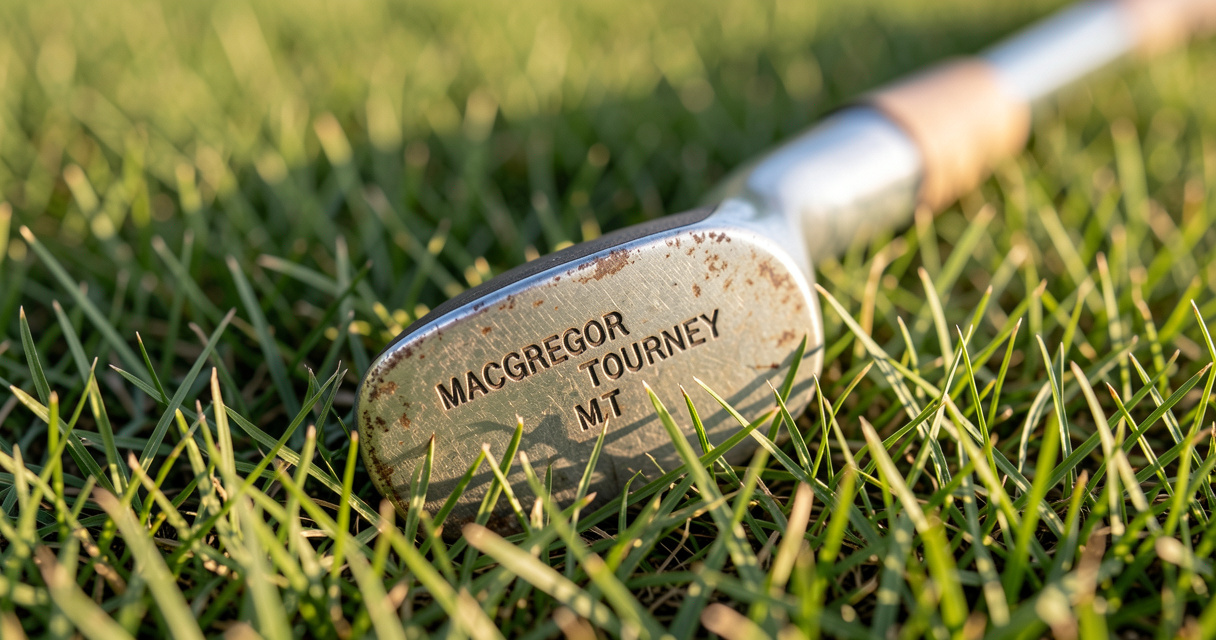
Every genuine MacGregor Tourney iron has a clear, stamped model designation on the sole. For vintage models: ‘MT’ or ‘MTR1’ with the year code often hidden in the serial. Modern models have ‘MACSPD’ or ‘MT Milled’ in a clean font. Look for uneven stamping – fakes often use laser engraving that looks too perfect. I’ve seen a fake R2MT where the ‘R’ was slightly smaller. Trust your eyes.
Decoding Ferrule and Shaft Bands
The ferrule – that ring between the hosel and shaft – holds clues. 1960s ferrules are black with one gold ring. 1970s models have two white rings. Modern MT Milled uses a plain black ferrule. The shaft band (if original) should say ‘Dynalite Gold’ or ‘True Temper Dynamic.’ If the shaft band says ‘S300’ but the club is a 1968 MT, be suspicious.
Cross-Referencing with Production Years
Use the Swing Yard chart (available online) to match the model with the production year. For example, the MT MTR1 was produced from 1968 to 1970. If you see a set listed as ‘1972 MT MTR1,’ it’s either mislabeled or a later model. Also, check the serial numbers: early models had a four-digit number starting with the year (e.g., 68XX = 1968).
- Step 1: Check the sole stamp for model codes (MT, R2MT, MTR1).
- Step 2: Look for a four-digit serial on the ferrule or shaft.
- Step 3: Note the ferrule color bands (black/white/gold indicate era).
- Step 4: Compare the design with the Swing Yard year chart.
- Step 5: Verify the original shaft label (Dynalite Gold or True Temper).
Featured snippet summary: To identify your MacGregor Tourney irons, start with the sole stamp (MT, R2MT, etc.), check the ferrule rings for era clues, locate the serial number (often on the ferrule), and cross-reference the design with the Swing Yard production year chart. Always confirm the shaft label is original – a mismatched shaft is a red flag.
Now let’s answer the most common questions that keep popping up in search results – the ones I hear on the practice green all the time.
Frequently Asked Questions About MacGregor Tourney Irons
How do I identify the year of my MacGregor Tourney irons?
Check the sole stamp (e.g., ‘MT’, ‘R2MT’, ‘MTR1’), the ferrule color bands, and the shaft label. Cross-reference with the Swing Yard production chart from 1936 to 1972. The serial number may include the year (e.g., 68XX for 1968).
What is the difference between MacGregor MT and R2MT irons?
MT models (1968-1970) have a split sole or standard sole; R2MT (1967) has a different sole design and shorter production run. The R2MT is rarer and often valued higher among collectors – typically $500–$800 vs $300–$700 for MT.
Are MacGregor Tourney irons good for beginners?
Vintage Tourney irons are primarily blades and muscle backs, suited for low handicappers. Modern MACSPD and MT Milled irons offer more forgiveness and are better for mid-to-high handicappers. If you’re a beginner, start with the MACSPD.
Where can I buy MacGregor Tourney irons in 2026?
New irons are available directly from MacGregorGolf.com. Used and vintage sets can be found on eBay, GolfWRX classifieds, and specialized vintage golf forums like the Golf Club Collectors Forum.
What is the value of a complete set of MacGregor Tourney MT irons?
Depending on condition, a complete 3-PW set of MT irons from the late 1960s can fetch $300-$800 on eBay. Rare models or sets with original shafts and grips can go higher – I’ve seen a set with original leather grips sell for $1,200.
Did Jack Nicklaus play MacGregor Tourney irons?
Jack Nicklaus used MacGregor VIP irons (designed for him) in the 1960s and 1970s, not the standard Tourney line. However, the VIP shares many design cues with the Tourney MT series – both were forged in the same facility.
How do MacGregor Tourney irons compare to modern forged irons like Mizuno?
Vintage Tourney irons offer a softer feel and classic look, but lack modern forgiveness and distance technology. Modern MACSPD and MT Milled irons compete directly with brands like Mizuno and Titleist in feel and performance – many GolfWRX users rate the MACSPD above the JPX923.
Conclusion: Which MacGregor Tourney Irons Are Right for You?
To recap: MacGregor Tourney irons have a rich history from the 1940s to present, offering models for every player. Vintage MT and R2MT irons are prized for their forged feel, but require skill to hit well. Modern MACSPD and MT Milled irons blend forgiveness with classic aesthetics. Always verify model and condition before buying – use the identification tips from this guide.
The decision comes down to your game and your goals. If you’re chasing that buttery feel of a 1968 MT, you’ll need to invest time in learning to swing pure – and maybe invest $500–$800. If you want modern performance with a nod to tradition, the MACSPD or MT Milled will serve you well for years. Walk the course. Hit a hundred balls with each club. The game doesn’t owe you anything, but MacGregor’s Tourney irons might just give you the purest feeling shot you’ll ever hit.

Playing golf since before GPS rangefinders existed. Eddie covers the classic game — courses, technique, and the stories worth keeping.