

Reading time: 16 min
Points clés à retenir
- Start line — Use the Gate Drill to build a square putter face and repeatable ball path.
- Distance control — The Ladder Drill and the 4×4 Lag Drill kill three-putts by leaving your first putt inside a makeable circle.
- Short putts — The Clock Drill and the 100 Consecutive Putts challenge build the confidence that ends missed 3-footers.
- 15 minutes a day — A structured putting practice routine beats an hour of aimless rolling on the practice green.
Stop rolling putt after putt without a plan. The next 15 minutes can change how you practice putting for good. Here’s the thing nobody talks about: the problem is not a lack of golf putting practice drills. It’s a lack of a system. Most golfers wander onto the practice green, hit four lag putts, five short ones, and walk away with no idea what they actually improved. The result is the same three-putts they walked in with.
This guide gives you a structured set of putting practice drills with success standards, at-home and on-course options, and a 15-minute daily routine that attacks your biggest weakness. Distance control, start line, and short-putt confidence — those are the three pillars. If you train them separately, they become automatic together.
Why Most Golfers Waste Their Putting Practice (And How to Change It)
An amateur arrives at the practice green, drops a handful of balls, and starts rapping 18-foot putts at the hole. Fifteen minutes later, he’s hit maybe twenty putts and learned nothing. That’s not practice. That’s rolling balls. The problem is no feedback. If a putt misses, you need to know why. Was the face open? Did the speed die before the hole? Did you start the ball right of your target? Without an answer, you’re just building in the same bad move.
Why Unstructured Putting Practice Fails
Unstructured practice fails because it has no goal. A drill should tell you whether you made it or missed it. The Gate Drill tells you exactly when the putter face was square. The Ladder Drill tells you if your distance control is off. The Clock Drill tells you whether you can handle a short putt when it matters. If you can’t tick a box at the end of the session, you didn’t practice — you just hit putts.
The 15-Minute Putting Rule
Here’s the rule: you can improve putting in 15 minutes a day if every minute has a purpose. Spend two minutes on eye alignment, five on start-line drills, five on distance control, and three on short putts. That’s the system in this article. It follows what Bobby Jones figured out decades ago: putting is a game of line and speed, and if you practice them separately, they become automatic together.
According to PGA Tour stats from the 2025 season, the average tour player leaves a 30-foot lag putt inside three feet. Amateurs often leave the same distance six to ten feet away. That’s not a talent gap — it’s a practice gap. If you train distance control, your three-putt percentage drops fast.
Now let’s start with the drill that fixes your start line.
The Gate Drill: Build a Repeatable Start Line in 5 Minutes
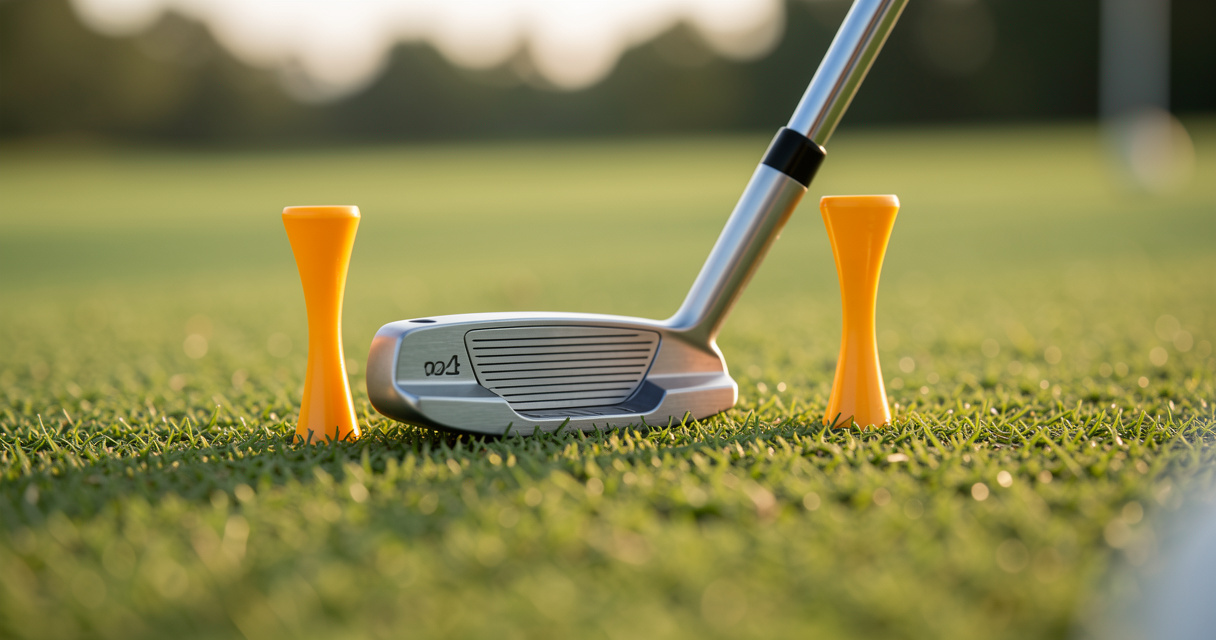
- Place two tees just wider than your putter head about four feet from your target.
- Center the ball between the tees.
- Rehearse solid center-face contact while passing through the gate.
- After three clean passes, build a second gate halfway to a hole five feet away.
- Hit nine balls in a row through the second gate; restart if you miss.
- Repeat daily to improve your start line and reduce three-putts.
How to Set Up the Gate Drill
Here’s what you need: two tees, one putter, one ball. Place the tees just wider than your putter head about four feet from the target. Center the ball between them. Make a stroke that passes through the gate without touching either tee. If you hit the tee, the putter face was not square through impact. This is the same putting gate drill standard Golf.com has used for years, and it still works because it gives instant feedback.
The 9-in-a-Row Success Standard
Once you can pass through the gate cleanly three times, build a second gate halfway to a hole five feet away. Hit nine balls in a row through the second gate. If one misses, restart. Nine in a row means your face-to-path relationship is holding under pressure. That’s the standard that will cut three-putts. Don’t move on until you hit it.
Troubleshooting: Why You Keep Hitting the Tees
Here’s a table I wish someone had handed me years ago. It explains exactly what your misses mean and how to fix them during the putting gate drill.
| Problem | Cause | Fix |
|---|---|---|
| Hitting right tee | Putter path is moving too far to the right through impact | Shorten your backswing and rehearse a square finish; let the putter release after the ball |
| Hitting left tee | Putter path is cutting across the ball from outside to in | Focus on keeping the putter head low through impact and stop the toe from turning over too early |
| Ball wobbles through the gate | Off-center contact | Run the Coin Drill to find the sweet spot, then return to the gate |
Keep the gate only slightly wider than your putter head. If the gate is too wide, you won’t fix face alignment — you’ll just reinforce sloppy contact.

Once your start line is reliable, the next problem is speed. That’s where the Ladder Drill comes in.
The Ladder Drill & Lag Putting: Master Distance Control From 10 to 40 Feet
Here’s the thing nobody talks about: most three-putts don’t come from misses inside five feet. They come from leaving the first one 12 feet away. If you stop doing that, you stop three-putting. A lag putt is the first putt from long range. The goal isn’t to make it — it’s to leave the second putt so short that three-putting is impossible.
Ladder Drill Setup and Speed Check
Place tees at 10, 20, 30, and 40 feet from a hole. Start at 10 feet. Your job is not to make the putt — your job is to stop the ball as close to the tee as you can. Each putt should finish within a putter length of the tee. If it stops short by more than that, you’ve misjudged speed. The ladder drill puts distance control at the center of your putting practice routine.
The 4×4 Lag Drill Challenge
Use four tees to create a four-foot square around a hole. From 30 feet, putt the ball so it finishes inside that square. The success standard is 18 balls in a row inside the square. If the ball leaves the square, restart. This is the 4×4 Lag Drill popularized by Golf.com, and it directly reduces three-putts by making your second putt manageable.
How to Use a 30-Foot Pace Count
Walk off ten paces from the hole. Add ten more. That’s twenty. Another ten and you’re at thirty. Your body now knows the distance without your eyes measuring it. In your stroke, use a consistent pace — the same rhythm for every putt, with only the length of the backswing changing. This is what the old caddies did, and it still works on modern greens.
| Drill | Purpose | Success Standard |
|---|---|---|
| Ladder Drill | Distance judgment at 10, 20, 30, 40 feet | Every putt stops within one putter length of the tee |
| 4×4 Lag Drill | Speed control from 30 feet | 18 balls in a row finish inside the four-foot square |
If your lag putting improves, your short putting gets easier. But you still have to close out the short ones.
The Clock Drill and Pressure Putting: Stop Missing Short Ones
Short putts are where rounds get saved and where rounds get thrown away. The Clock Drill and the 100 Consecutive Putts challenge are the best short putting drills I know. They’re simple, measurable, and brutally honest.
The Clock Drill: 3, 6, 9 and 12
Place balls at 3, 6, 9, and 12 o’clock around a hole, three feet out. Make all four in a row. Move to four feet. Make all four. Move to five feet. This exposes your breakdown point. When you miss, you learn exactly where your stroke breaks under pressure.
- Place four balls around the hole at 3 feet.
- Make all four consecutively.
- Move to 4 feet and repeat.
- Move to 5 feet and repeat.
- If you miss, restart that circle.
The 100 Consecutive Putts Challenge
From two to three feet, putt until you make 100 in a row. If you miss, start over. This is a mental drill as much as a technical one. It builds the confidence that makes short putts automatic when your hands are shaking on the 16th green. I’ve missed at 97. It hurts. But the next time you face a two-footer in a match, you’ll know you’ve already made a hundred in a row.
You can run all three of these pillars at home, too. That’s the key to real improvement.
At-Home Putting Drills: Improve Without Leaving Your Living Room
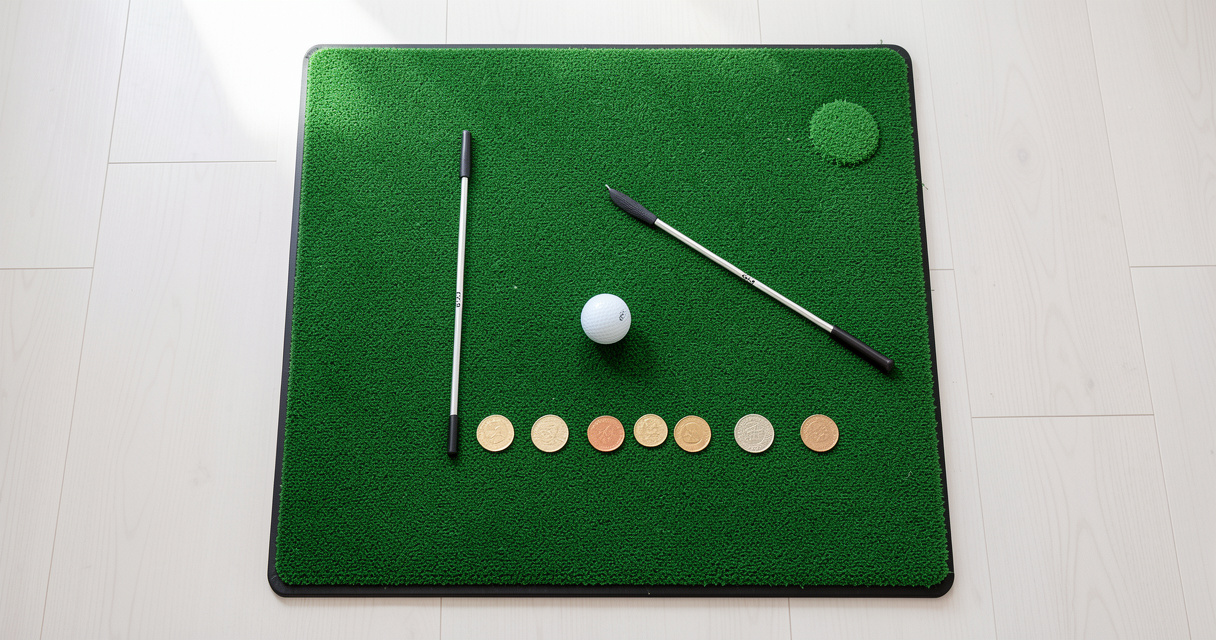
You don’t need a putting green to improve. I’ve played that shot a thousand times on a living room mat. With a mat, a ruler or alignment stick, and a few coins, you can run most of the drills in this article at home. These putting drills for home are the same ones BirdieBall teaches, and they work because they give you feedback every single stroke.
Straight Putt Drill With a Ruler or Alignment Stick
Lay a ruler or alignment stick on your mat along your target line. Put the ball next to it. Stroke the putt without knocking the stick. If you can roll the ball along the edge of a ruler, your face is square through impact. This is the purest putting drill for home because it isolates face angle and path in one move.
Gate Drill With Coins
Use two coins instead of tees. Place them on either side of the putter head. Hit putts through the gate. The coins will move when your putter head is off line. Start close to the hole, then move the gate farther away. You can run a full putting gate drill without leaving your house.
One-Handed Putting Drill for Feel
Tiger Woods still uses the one-handed drill as a warm-up. Hit short putts with your right hand only, then left hand only. It forces the putter head to release naturally and makes you feel the weight of the stroke. Coach Scott Munroe has explained that a toe-hang putter hangs the face open during release, which is why one-handed work helps control rotation.
The Coin Drill for Center-Face Contact
Place a coin or a dime on the center of your putter face. Hit putts with the edge of the coin. If the ball doesn’t roll true, you’re off center. This is old-school and it still works. Nothing kills distance control faster than missing the sweet spot.
| At-Home Drill | Equipment | Skill Focus |
|---|---|---|
| Straight Putt Drill | Ruler or alignment stick | Face angle and path |
| Gate Drill With Coins | Two coins | Start line |
| One-Handed Putt | Putter only | Feel and release |
| Coin Drill | Coin and putter | Center-face contact |
A toe-hang putter is one where the toe hangs downward when the putter is held level. This design opens the face during release, and the one-handed drill teaches you to control that rotation instead of fighting it.
Feel Drills: Develop Distance Control Without Looking at the Hole
Most putting instruction talks about mechanics. But feel wins on Sundays. The best lag putters on tour aren’t thinking about face angle from 40 feet; they’re feeling the distance. Here’s a drill that forces your hands and body to sense speed instead of grabbing for a mechanical swing thought.
The Look-Away Drill
Place a ball 20 feet from the hole. Look at the hole, then close your eyes and make the stroke. Don’t watch the ball roll. Your brain estimates distance from what you saw before the putt, and that trains distance control better than pulling your eyes back to the ball at impact. I know it feels strange the first few times. That’s normal.
The 3-Ball Speed Ladder
Drop three balls at 15, 20, and 25 feet. Putt each one with the same rhythm, changing only your backswing length. The goal is not to make them; it’s to stop all three within two feet of the hole. This is a lag putting drill that sharpens your touch without a single mechanical thought.
Feel drills pair perfectly with alignment drills, because you need to see the line before you can feel the speed.
Alignment and Eye Position: The Drill That Helps You See the Correct Line
You can have perfect mechanics and still miss because you aimed the putt where you weren’t looking. Eye alignment is one of the most overlooked pieces of putting. The eye exam drill and the alignment-stick drill will fix it.
The Eye Exam Drill
From 20 feet, stand beside your ball, close your eyes, and point your putter or your hand at the hole. Open your eyes and see where the line sits. If you’re pointing left, your perception is off. This drill comes from the teaching staff at Superstition Mountain and it’s a killer. It takes two minutes and it tells you more about your green reading than five minutes of practice putts.
Find Your True Eye Position With an Alignment Stick
Lay an alignment stick parallel to your target line. Set up as you normally would. Drop a ball from your eyes and see where it lands. If it lands inside the stick, your eyes are too far inside. If it lands outside, you’re too far over the ball. Adjust until your eyes sit directly over the ball or just inside the line — whatever produces your true line. This is the eye alignment putting drill every serious putter needs.
If the target line looks like it crosses left of the hole, your eyes are probably too far inside. Adjust until the line points dead center.
Now let’s put all of this into one repeatable putting practice routine.
How to Build a 15-Minute Putting Practice Routine
The best putting practice routine is one you can repeat daily. Here’s a 15-minute session that covers every pillar of putting. No wasted time, no aimless rolling, just measurable work.
The 15-Minute Putting Session
| Time | Focus | Drill |
|---|---|---|
| 2 minutes | Alignment and eye position | Eye Exam Drill or alignment stick drill |
| 5 minutes | Start line | Gate Drill — 9 in a row through the second gate |
| 5 minutes | Distance control | Ladder Drill or 4×4 Lag Drill |
| 3 minutes | Short putts | Clock Drill — all four from 3, 4, 5 feet |
A Simple Weekly Putting Practice Schedule
Here’s a schedule that alternates home mat work and on-course putting green work. You’ll notice one rest day and one easy day. Putting practice should be focused, not exhausting.
| Day | Location | Drills | Goal |
|---|---|---|---|
| Monday | Home mat | Gate Drill with coins, Coin Drill | 20 minutes, clean face contact |
| Tuesday | Putting green | Ladder Drill, Clock Drill | 30 minutes, speed and short putts |
| Wednesday | Rest or light roll | One-handed putts | 10 minutes, feel only |
| Thursday | Home mat | Straight Putt with ruler, Coin Drill | 20 minutes, square face |
| Friday | Putting green | Gate Drill, 4×4 Lag Drill, Clock Drill | 35 minutes, full routine |
| Saturday | Before round | Gate Drill and 5 short putts | 10 minutes, confidence |
| Sunday | Rest | None | Let it sink in |
Practice Scorecard
Write this down or print it out. A practice scorecard forces you to own your session. If you don’t score it, you don’t know if you improved.
| Drill | Session 1 | Session 2 | Session 3 | Session 4 |
|---|---|---|---|---|
| Gate Drill (balls through gate) | /9 | /9 | /9 | /9 |
| Ladder Drill (balls inside target) | /18 | /18 | /18 | /18 |
| Clock Drill (putts made) | /12 | /12 | /12 | /12 |
Last spring, a 15-handicap player I know started running this routine. Four weeks later, his three-putts went from four per round to two. He didn’t change putters. He didn’t watch a video. He just started each practice session with a target and stopped when the drill was complete. The game doesn’t owe you anything. But it does reward focused repetition.
Frequently Asked Questions
How many putting drills should you do in one practice session?
Focus on two or three drills for 15 to 30 minutes: one for start line, one for distance control, and one for short putts. Quality beats quantity every time.
What is the best putting drill for beginners?
The Gate Drill and the Straight Putt Drill are ideal because they give immediate feedback on face-to-path alignment and help beginners feel a square putter face.
How long should you practice putting with a putting mat at home?
Ten to fifteen minutes per day is enough if you use a drill with a goal. Aimless repetition reinforces bad habits; structured practice improves them.
Why do I keep three-putting?
Three-putting is usually a distance-control problem, not an aim problem. The Ladder Drill and the 4×4 Lag Drill develop the speed control needed to leave the first putt close.
Does the one-handed putting drill really help?
Yes. It builds feel, touch, and awareness of how much energy the stroke needs. Tiger Woods uses it as a warm-up because it forces the putter head to release naturally.
What is the best putting drill to stop pulling putts?
The Gate Drill with two tees exposes face and path problems. If you keep pulling the ball, check where your eyes sit and whether your putter path is moving to the inside.
Can putting drills improve my putting from 10 feet?
Yes. Eye alignment drills help you see the correct line, while Ladder and Lag drills improve speed control. Combined, they turn more 10-foot putts into realistic birdie chances.
Putting Practice Drills That Actually Lower Your Score
Here’s what all of this comes down to: pick one start-line drill, one distance-control drill, and one short-putt drill. Run them for 15 focused minutes a day. The Gate Drill and the Lag Drill have clear standards — 9 in a row and 18 in a row. At home, use a ruler, coins, and the one-handed drill. On the green, use the Ladder and the Clock.
The game doesn’t owe you anything. The next time you walk onto the putting green, don’t just place a ball and hit. Choose one drill, set a target, and write down your score. Repeat that daily for two weeks, and watch your putts per round fall. Walk the course. You’ll understand.

Playing golf since before GPS rangefinders existed. Eddie covers the classic game — courses, technique, and the stories worth keeping.